Your author bio may be one of the shortest pieces of writing you create, but it has an unusually important job.
It must quickly tell readers who you are, what you write, why they should trust you, and what they should do next. That is a great deal to ask of 50, 100, or even 150 words.
Yet many author bios read like miniature résumés. They begin with a degree earned decades ago, continue with a list of unrelated jobs, and end with a pleasant detail about where the author lives. The information may be accurate, but it does not necessarily help a reader decide whether the author's books are meant for them.
A strong author bio does double duty: it builds trust and gently guides the reader toward a next step—buying the book, joining a newsletter, following the author, requesting an interview, or exploring another title.
In other words, your bio is not simply a summary of your life. It is a compact positioning statement with a purpose.
Here is how to write one that actually works.
1. Begin With Relevance, Not Chronology
Your bio does not need to start at the beginning of your life or career. It should start with the detail that matters most to the reader standing in front of this particular book.
Ask yourself:
What makes me especially qualified—or particularly interesting—as the person who wrote this book?
For a nonfiction author, that might be professional expertise, lived experience, research, or a record of helping people solve the problem addressed in the book.
For a fiction author, credibility may come from an unusual career, firsthand knowledge of a setting, a lifelong fascination with the genre, or a distinctive creative point of view.
Compare these openings:
Less effective:
Jane Smith graduated from Fairview College and has worked in several industries throughout her career.
More effective:
Former homicide detective Jane Smith writes psychological thrillers that explore the secrets people protect—and the investigators determined to uncover them.
The second version immediately connects the author's experience to the books she writes. It answers the reader's unspoken question: Why should I pay attention to this author?
That does not mean education and employment history never belong in a bio. Include them when they strengthen the reader's understanding of your authority. A financial planner writing about retirement, a grief counselor writing about loss, or a historian writing about a specific era may have highly relevant credentials. The test is not whether an accomplishment is impressive. The test is whether it supports the promise of the book.
2. Identify Your Genre or Niche Quickly
Readers scan before they read closely. Within the first sentence or two, they should understand what kind of work you create and whether it matches their interests.
Consider the clarity of these examples:
Maya Torres writes warm, witty second-chance romances featuring ambitious women and the communities that cheer them on.
Daniel Reed helps first-generation entrepreneurs turn practical expertise into sustainable service businesses.
A. J. Morgan writes atmospheric historical mysteries inspired by forgotten places and unresolved secrets.
Each sentence gives the reader a category, a tone, and a reason to continue. That is much more useful than simply saying someone is “an author, speaker, and entrepreneur.” Broad labels may be true, but specificity makes a bio memorable.
If you write in more than one genre, lead with the work most relevant to where the bio will appear. Your thriller bio does not need to give equal space to your children's books. Your speaker introduction may emphasize different credentials than your Amazon Author Page. You are not being inconsistent; you are selecting the most useful information for that audience.
3. Use Third Person—Most of the Time
Third person remains the most versatile choice for author bios. It is the standard format for:
- Book covers and interiors
- Amazon and retailer author pages
- Media kits and press materials
- Conference programs
- Guest articles and interviews
- Speaker introductions
It also allows a host, journalist, bookseller, or event organizer to copy and use the bio without rewriting it.
First person can work beautifully in more personal spaces, such as a newsletter welcome page, a conversational website About page, or a social profile. It can feel immediate and warm:
I write uplifting mysteries for readers who like their clues clever, their communities close-knit, and their endings satisfying.
The key is to make the choice intentionally. If you want one dependable bio that can travel across platforms, third person is usually the safest starting point.
4. Add Proof Without Turning the Bio Into a Trophy Case
Awards, bestseller status, media appearances, professional credentials, notable publications, and reader milestones can all establish trust. The strongest bios include the most relevant proof briefly and confidently.
For example:
- “USA Today bestselling author”
- “Winner of the Gold Medal for Historical Fiction”
- “Her essays have appeared in The Atlantic and Publishers Weekly”
- “He has helped more than 500 small-business owners strengthen their sales systems”
One or two carefully chosen credibility markers usually carry more weight than an exhaustive list. If you have many awards or media mentions, create a separate honors or press page and link to it from your website.
Newer authors should not assume they have no social proof. Relevant experience, years devoted to a field, specialized research, community leadership, professional certifications, or the number of people served can all establish credibility. Even a clear description of your commitment to a subject can build trust when it is specific and honest.
Never inflate a credential or use a label readers could reasonably misinterpret. Trust is much harder to rebuild than it is to establish accurately the first time.
5. Include One Human Detail Readers Can Remember
Credentials make you believable. Personality makes you memorable.
A single well-chosen detail can help a reader feel connected to the person behind the book:
When she is not plotting fictional crimes, she is usually searching for antique maps or trying to win the approval of her bookstore-rescue cat.
He develops his best leadership ideas during long walks with a notebook and a very opinionated terrier.
A lifelong collector of family recipes, she believes every kitchen keeps at least one untold story.
The detail should feel natural, fit your voice, and ideally reinforce your genre or brand. A cozy mystery writer can be playful. A trauma specialist may choose warmth without whimsy. A business strategist might mention a habit that humanizes them while preserving authority.
Keep it to one strong detail. A parade of pets, hobbies, favorite foods, travel destinations, and family facts can crowd out the information readers need most.
6. Match the Voice of the Bio to the Voice of the Book
Your bio is part of the reader's experience. Its tone should make the transition into—or out of—your book feel natural.
A cozy mystery author might sound warm and lightly mischievous:
Clara Bell writes small-town mysteries filled with suspicious neighbors, inconvenient clues, and enough pie to keep every amateur sleuth properly fueled.
A leadership author may sound direct and authoritative:
Marcus Hill advises founders and executive teams on building accountable cultures without sacrificing trust.
A memoirist may use a more reflective tone:
Lena Brooks writes about grief, reinvention, and the quiet choices that help us find our way home to ourselves.
Tone creates an expectation. If your romantic comedy is playful but your bio sounds like a corporate annual report, readers experience a subtle disconnect. If your nonfiction book addresses a serious issue but your bio is overly casual, you may weaken your authority before the first chapter begins.
Read your bio aloud. Does it sound as though it belongs beside your book? If not, the information may be right while the voice is wrong.
7. End With a Genuine Call to Action
This is the opportunity many authors miss.
A bio often ends with a line such as, “She lives in Portland with her husband and rescue dog.” That is a pleasant human detail, but it does not tell the reader what to do next.
A true call to action creates a clear path forward:
- “Join her newsletter at [website] for bonus chapters and early access to new releases.”
- “Explore his free book-marketing resources at [website].”
- “Follow her on Instagram at [handle] for research notes and behind-the-scenes updates on Book Three.”
- “Book him for workshops and interviews at [website].”
- “Discover the next book in the series at [website].”
Choose one primary next step. Asking readers to visit a website, subscribe, follow five social accounts, buy three books, and request a speaking engagement creates too many competing decisions.
The right call to action depends on where the bio appears. On a book's final page, you might direct readers to the next title or a reader magnet. In a media kit, you might direct journalists to an interview page. On a guest post, newsletter signup may be the most valuable next step.
Your call to action should not merely serve your marketing goals. It should offer the reader something useful: more stories, a helpful resource, exclusive content, practical guidance, or an easy way to stay connected.
8. Create More Than One Version
There is no single author bio that works perfectly everywhere. Prepare several approved versions before you need them.
The one-line bio
Best for bylines, anthologies, podcast descriptions, contributor lists, and places with strict character limits.
Formula:
[Name] writes [genre or niche] for [audience], helping them [benefit] or inviting them into [distinctive reading experience].
Example:
Nina Clark writes hopeful contemporary fiction about women rebuilding their lives, careers, and communities.
The short bio: approximately 50 words
Best for back covers, retailer pages, guest posts, and event programs.
Include your genre or niche, one credibility marker, one memorable detail, and—when space permits—a simple next step.
Example:
Nina Clark writes hopeful contemporary fiction about women rebuilding their lives and communities. A two-time regional fiction award winner, she collects handwritten recipes and overheard conversations. Join her newsletter at NinaClarkBooks.com for reading guides, bonus scenes, and news about her next novel.
The medium bio: approximately 100 words
Best for podcast introductions, book-club materials, online profiles, and article contributor pages.
This version gives you room to add a little more context about your work, audience, or authority without telling your entire life story.
The long bio: approximately 150–250 words
Best for your website, media kit, speaker page, award submissions, and event proposals.
A longer bio may include:
- Your central body of work
- Relevant professional or lived experience
- Selected awards, publications, or media appearances
- The themes that connect your books
- Speaking, teaching, or community work
- One personal detail
- One purposeful call to action
Longer does not mean less focused. Every sentence should still help the reader understand your work, trust your authority, remember you, or take the next step.
9. Adapt the Bio to Its Location
Think of your core bio as a master document, not a block of text you paste everywhere unchanged.
| Location | What to emphasize | Best next step |
|---|---|---|
| Back cover | Genre, promise, credibility | Visit author website or discover next book |
| Amazon Author Page | Books, series, reader appeal | Follow the author or explore other titles |
| Website About page | Story, mission, complete body of work | Subscribe, contact, or browse books |
| Media kit | Expertise, awards, interview topics | Request an interview or appearance |
| Speaker page | Outcomes, experience, signature topics | Inquire about availability |
| Guest article | Relevance to the article topic | Visit a focused resource or signup page |
| Social profile | Clear identity and personality | Follow or click one primary link |
You do not need to reinvent your identity for every platform. Change the emphasis and the call to action while keeping your central message consistent.
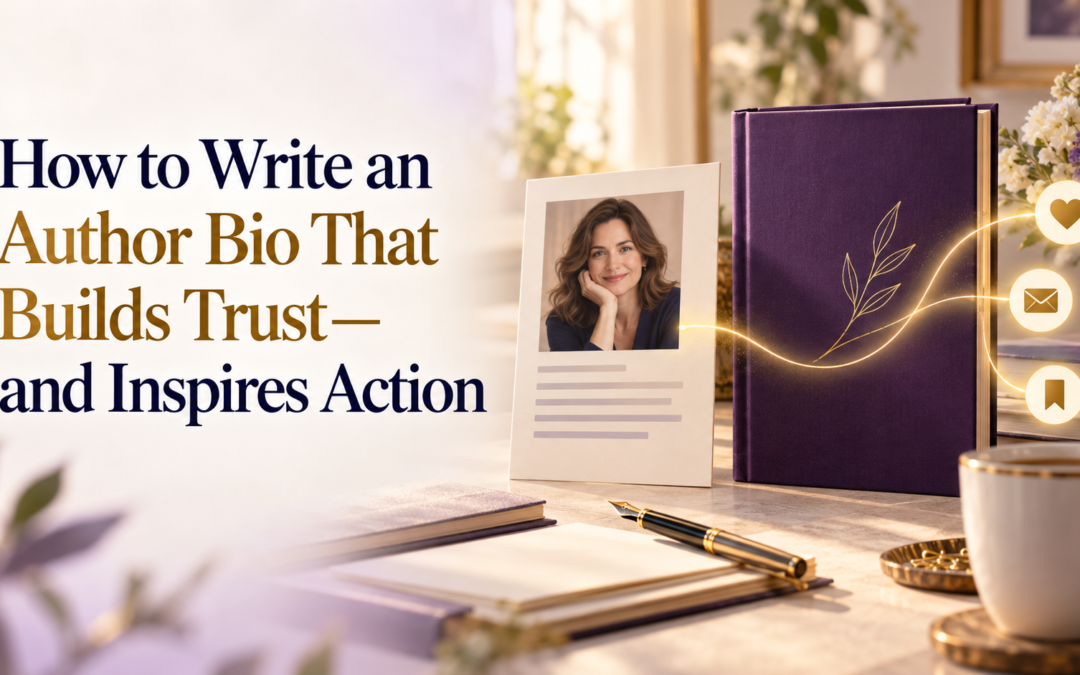
10. Pair the Words With a Professional Headshot
Readers connect a face with a name. A current, friendly, high-quality headshot can reinforce the trust your words are working to build.
Your photo does not need to be stiff or formal, but it should be intentional. Use good lighting, a clear background, appropriate clothing, and an expression that fits your brand. A thriller author and a children's author may make very different visual choices, and both can be right.
Use the same primary headshot across your website, retailer profiles, media kit, and key social accounts whenever possible. Consistency strengthens recognition. Keep both a high-resolution image for print and a web-optimized version, and update the photo when it no longer resembles how you currently appear.
Common Author Bio Mistakes
Before publishing your bio, check for these frequent problems:
Beginning too far back
“Jane has loved writing since she was six” is meaningful only if it leads somewhere specific. Start with what Jane writes now and why readers should care.
Listing everything
A bio is curated, not comprehensive. Save the full chronology for your résumé or extended About page.
Using vague language
Phrases such as “award-winning author,” “thought leader,” or “passionate storyteller” are stronger when supported by specifics. Which award? What subject? What kind of stories?
Writing for other authors instead of readers
Conference appearances, writing-group memberships, and publishing-process details may impress peers but mean little to the book's intended audience. Keep the reader at the center.
Trying too hard to be quirky
Personality should make you more relatable, not obscure your work. If the clever detail becomes the main event, scale it back.
Forgetting to update it
An outdated bio can omit your newest book, repeat an old launch message, include a discontinued website, or describe an award as “recent” years later. Review your bios at least twice a year and whenever you release a book, receive significant recognition, change your positioning, or update your preferred call to action.
Ending without a path forward
If a reader likes what they have learned, make the next step obvious and easy.
A Flexible Author Bio Template
Use this framework as a starting point rather than a rigid formula:
[Name] writes [genre or niche] for [audience or reader type], exploring/helping them [core theme, problem, or promise]. [Relevant experience, credential, accomplishment, or selected social proof]. When not writing, [one memorable human detail]. [One clear call to action with website, newsletter, next book, or social destination].
Fiction example
Elise Warren writes atmospheric mysteries about old houses, complicated families, and secrets that refuse to stay buried. Her debut novel won the Harbor Light Award for Mystery. When she is not inventing motives, she explores historic neighborhoods with a camera and a notebook. Visit EliseWarrenBooks.com for a free prequel story and updates about her next case.
Nonfiction example
Jordan Ellis helps independent professionals turn what they know into clear, useful books that build authority and create new opportunities. A publishing strategist and workshop leader, Jordan has guided more than 200 experts through the manuscript-development process. Away from the desk, Jordan is usually rearranging a home library that has officially run out of walls. Download the free Author Positioning Guide at JordanEllis.com.
The Author Bio Checkup
Before you publish or submit your bio, ask:
- Does the opening tell readers what I write and whom I serve?
- Have I included the experience or proof most relevant to this book?
- Does the tone match my genre, subject, and author brand?
- Is every credential specific, accurate, and useful?
- Have I included one memorable human detail?
- Have I removed information that belongs in a résumé instead?
- Is the bio the right length for where it will appear?
- Does it give the reader one clear next step?
- Is the link, title, handle, and other information current?
- Is it paired with a recent, professional headshot where appropriate?
If you can answer yes to each question, your bio is doing more than filling space. It is helping the right reader recognize you, trust you, remember you, and continue the relationship.
Your Bio Is a Bridge
An effective author bio connects the book a reader has just discovered with everything you hope they will discover next.
It does not need to include every accomplishment or explain every turn in your journey. It needs to make a clear promise, offer credible evidence, reveal a glimpse of the person behind the words, and open one inviting door.
That is the real work of an author bio: not simply to tell readers who you are, but to help them understand why your work may matter to them—and make it easy to stay connected once it does.
Your turn: Read your current author bio as if you were encountering your work for the first time. Within five seconds, would you know what you write, why you are credible, and what to do next?