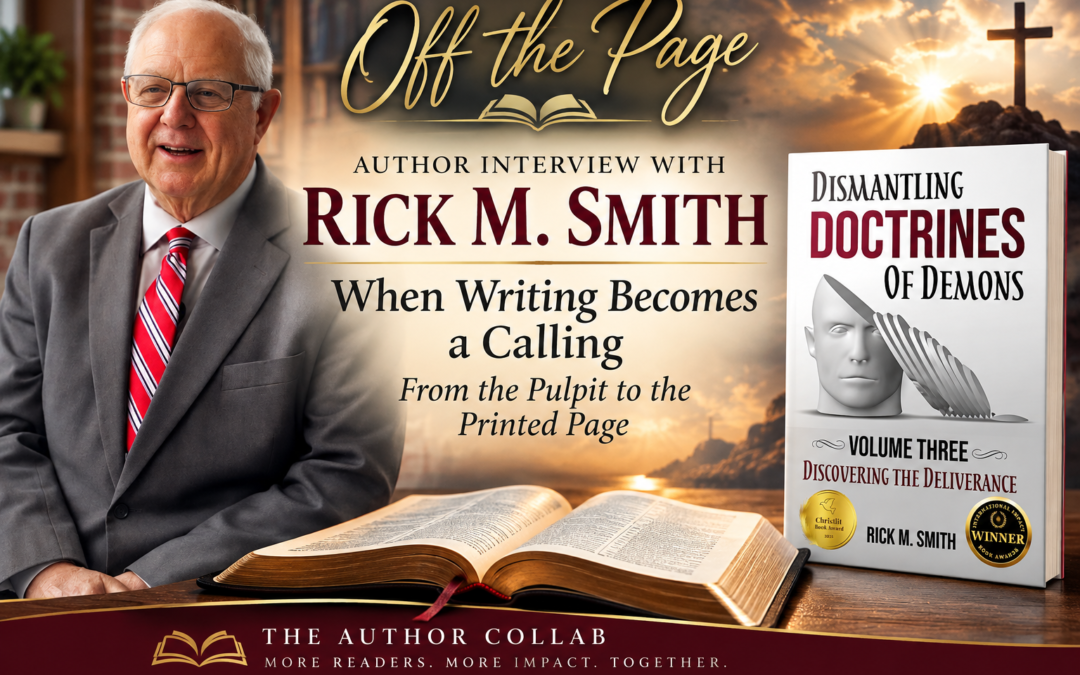
From the pulpit to the printed page, the author of Dismantling Doctrines of Demons shares how faith, purpose, and a lifetime of teaching inspired his three-volume series.
By The Author Collab | Off the Page Author Interview Series
Some authors begin their writing journeys with a lifelong dream of seeing their names on a book cover. Others discover that the stories, lessons, and convictions they've carried for decades are asking to be shared in a new way.
For Rick M. Smith, becoming an author was never part of a carefully mapped-out career plan. After more than 45 years of studying and teaching Scripture, serving in ministry, and sharing his faith through Southern Gospel music, writing became another expression of what he considers his life's calling.
His three-volume series, Dismantling Doctrines of Demons, grew from a collection of sermons into an extensive manuscript exploring biblical prophecy, spiritual warfare, cultural change, and Christian faith.
What began as approximately 500 pages of research, reflection, and theological interpretation eventually became three interconnected books:
- Volume One: Disclosing the Darkness
- Volume Two: Defining the Doctrines
- Volume Three: Discovering the Deliverance
But Rick's story extends well beyond the books themselves.
His experiences in broadcasting, music, ministry, marketing, and funeral service have shaped the way he communicates difficult subjects and connects with readers. His journey also offers an important reminder to aspiring authors: sometimes the book you are meant to write emerges from the work you've already spent a lifetime doing.
In this edition of Off the Page, Rick discusses the inspiration behind his series, the responsibilities he believes come with faith-based writing, the advice that transformed one enormous manuscript into three books, and why he believes the written word can continue changing lives long after its author is gone.
A Lifetime of Words, Music, and Ministry
The Author Collab: You've spent more than 45 years studying and teaching Scripture. What first drew you to this work, and what keeps you committed to it today?
Rick M. Smith: Over the years, people have often told me, "You are good with words." I suppose that developed through my high school interest in speech and drama, my first jobs in radio broadcasting, leadership in church ministry and worship, and performing as a Southern Gospel artist for much of my life.
I've done a great deal of writing throughout my life, particularly in preparing Bible teachings and handling various aspects of church administration. Even in my secular work involving marketing and promotion, content development has played a significant role.
But I never had specific aspirations to become a published author. That grew out of focused study of Scripture and a desire to understand how biblical truth is revealed and remains relevant in the world around us.
Writing simply for the sake of writing holds little interest for me. There must be a purpose, and for me, that purpose must carry a sense of divine assignment.
I surrendered my life to the ministry of biblical truth when I was sixteen years old. That is a lifetime assignment. Whether preaching, teaching, singing, or writing, proclaiming that truth remains my passion and priority.
I believe whatever gifts or talents I possess were placed in my life by God to bring glory and honor to Him.
When I published these books, I sincerely prayed that God would place them in the hands of those who needed their message most. I would do my part in publishing and promotion, but their ultimate success would rest in His hands, whether ten people read them or ten thousand.
For me, writing is not a hobby or a side job. It is an extension of a calling.
From a Sermon Series to a Three-Volume Collection
The Author Collab: What prompted you to write the Dismantling Doctrines of Demons series, and how did one manuscript become three books?
Rick: The inspiration emerged during the period leading up to the 2020 presidential election.
As I observed the political and cultural landscape, I became increasingly concerned about changes taking place in American society. From my biblical perspective, these developments raised questions about the spiritual influences behind cultural and political movements.
One day, while studying Scripture, I encountered a passage in I Timothy 4:1 concerning people turning away from faith and following what the Apostle Paul described as "doctrines of demons."
That passage became a defining moment for me.
I began examining what such doctrines might look like and eventually organized my thinking around five categories: dominance, deception, deviation, division, and death.
In the fall of 2020, I preached a sermon series on those five doctrines at the small church where I serve as pastor.
Months later, I returned to my notes and began studying, researching, and journaling more extensively. I hadn't intended to write a book, but as the material developed, I realized it could become one.
I completed a manuscript of approximately 500 pages and sent it to about a dozen trusted friends, family members, and colleagues in ministry.
Their feedback was encouraging, particularly regarding the theological framework. However, several people pointed out that a 500-page faith-based nonfiction book by an unknown independent author might be a difficult undertaking for readers.
One person suggested dividing it into multiple books.
When I revisited the manuscript, I realized that its structure naturally lent itself to three volumes.
The first, Disclosing the Darkness, examines what I understand to be the spiritual origins and manifestations of evil in contemporary society.
The second, Defining the Doctrines, explores the five categories I identified and how I believe they operate within culture.
The third, Discovering the Deliverance, examines biblical prophecy, future events as I interpret them, and the Christian message of deliverance through faith.
What started as a series of sermons became a much larger literary undertaking than I ever imagined.
The Question at the Heart of the Third Book
The Author Collab: For someone encountering Discovering the Deliverance first, what central question do you hope the book helps them explore?
Rick: The central question is simple: "How can I escape what is coming?"
My approach to Scripture is rooted in the conviction that the Bible is God's authoritative Word. I believe its prophetic passages reveal significant events that have yet to unfold.
In Discovering the Deliverance, I examine those passages, particularly the prophecies found in Revelation, and consider their implications for the future.
Some of the material is unsettling because it deals with judgment, suffering, and the events I believe Scripture describes as part of the end times.
But the purpose of the book is not merely to describe frightening possibilities.
It is to communicate hope.
From my Christian perspective, God has provided a way of deliverance through a genuine relationship with Jesus Christ.
I want readers to understand that message and consider what it means for their own lives.
Connecting Ancient Scripture with Modern Events
The Author Collab: You connect current events with your interpretation of biblical prophecy. How do you approach that connection, particularly for readers unfamiliar with the subject?
Rick: Biblical prophecy contains symbols, historical references, and passages that require careful interpretation.
Some symbols become clearer through deeper study of their context. Others remain subjects of considerable discussion among biblical scholars.
My approach is to study Scripture diligently, considering what should be understood literally, what may be symbolic, and what has already been fulfilled.
I believe Jesus taught that certain world conditions could serve as signs connected to prophetic events.
In my books, I explore how contemporary developments might relate to those passages.
For example, I consider the growth of digital currencies, changes in financial systems, and increasing global interconnectedness in relation to my interpretation of biblical descriptions of future world government.
I recognize that interpretations of prophecy can differ. My goal is to explain the scriptural reasoning behind my conclusions and encourage readers to examine these matters thoughtfully.
Finding Hope in Difficult Subjects
The Author Collab: Your books address subjects that some readers may find frightening or controversial. What does deliverance mean in the context of your writing?
Rick: For me, deliverance is ultimately about the transforming power of faith in Jesus Christ.
I believe spiritual warfare is a reality, although it may not always appear in the dramatic ways people imagine.
My books focus less on demonic possession and more on what I understand to be the spiritual influences operating throughout our world.
At the heart of my message is the belief that a genuine relationship with Christ involves three interconnected elements: belief, commitment, and lifestyle.
Belief means understanding and accepting who Christ is and what He has accomplished.
Commitment means making a personal decision to follow Him.
Lifestyle means allowing that commitment to produce meaningful transformation in how we live.
I want readers to understand that faith is more than intellectual agreement. It is a relationship that changes a person's life.
While my books address difficult prophetic themes, I hope readers ultimately encounter a message of redemption, grace, and hope.
Writing About the Difficult Things
The Author Collab: How has serving as a pastor shaped the way you write about complex or challenging topics?
Rick: The Bible doesn't hide the difficult realities of life.
Its characters make good decisions and bad ones. They experience triumph, failure, suffering, and restoration.
Throughout my ministry, I've followed an expositional approach to preaching and teaching, examining Scripture verse by verse.
When you commit to that approach, you don't have the luxury of simply skipping the difficult passages.
You encounter them, study them, and work to understand their meaning.
That same philosophy influences my writing.
I believe difficult subjects deserve careful examination, even when they challenge commonly held opinions or cultural assumptions.
My responsibility, as I understand it, is to communicate biblical teaching as faithfully and clearly as possible.
The ultimate purpose is not controversy for its own sake. It is helping people develop deeper understanding, wisdom, and faith.
Lessons in Hope from Serving Families
The Author Collab: You also serve families as a funeral director. Has that experience influenced how you think about faith, uncertainty, and hope?
Rick: Absolutely.
Over the past ten years, I've worked with more than 500 families planning funeral services for loved ones.
That experience brings you face-to-face with grief in all its forms.
I've encountered families with deeply held spiritual convictions and others who have little or no belief in life after death.
Those experiences have reinforced the importance of hope in my own faith.
For Christians who believe in eternal life through Jesus Christ, grief can coexist with the expectation of reunion.
That doesn't eliminate sorrow, but it changes how we understand loss.
I've also witnessed what I believe to be remarkable examples of spiritual transformation.
In the third volume, I share the story of my brother, who struggled with alcoholism before experiencing what he describes as a life-changing encounter with God during rehabilitation.
He credits that experience with freeing him from his desire for alcohol and has maintained sobriety for nearly twenty years.
Stories like his reinforce my conviction that no life is beyond the possibility of redemption and transformation.
That message of hope is central to everything I write.
What Music Taught Him About Reaching People
The Author Collab: Before becoming an author, you traveled as a Southern Gospel vocalist. What did music teach you about reaching people that you still bring to your writing?
Rick: I believe my spiritual gift is teaching.
I've taken spiritual gifts inventories many times, and teaching consistently ranks highest.
Whether I'm preaching from a pulpit, speaking from a podium, singing on a stage, writing a blog, or publishing a book, I see each activity as a different way of exercising that gift.
Music has a remarkable ability to communicate.
A song combines words, melody, rhythm, and emotion in a way that can reach people deeply.
One of the things that always amazed me about recording music was realizing that a performance could be preserved and heard decades later.
Someone might listen to that recording long after the original performance and still be moved by its message.
Books offer that same extraordinary possibility.
We write something today, place it into the world, and it may reach someone years or even decades from now.
We may never know whose hands a book will fall into or how its message might influence that person's life.
To me, that is one of the most meaningful aspects of writing.
The Advice That Changed Everything
The Author Collab: Has a reader or mentor said something about your writing that stayed with you?
Rick: One of the most meaningful responses came from Dr. Bob Agee, President Emeritus of Oklahoma Baptist University.
Dr. Bob was my pastor when I was a teenager growing up in Memphis, Tennessee, and he was also related to my family through marriage.
He was among the people I asked to evaluate my original manuscript.
I greatly respected his theological scholarship, so his assessment was particularly important to me.
He encouraged my writing and affirmed the diligence I had devoted to making Scripture clear and applicable.
He also believed the material could be valuable for readers interested in devotional Bible study and biblical prophecy.
His encouragement meant a great deal.
He was also among those who suggested that the original manuscript would be more effective if divided into multiple books.
Looking back, that was an important turning point.
His response gave me confidence that the material deserved further development and that I was moving in the right direction.
For an independent author undertaking a first major publishing project, encouragement from someone you deeply respect can be incredibly meaningful.
Life Beyond the Writing Desk
The Author Collab: When you step away from writing and ministry, what brings you joy?
Rick: Family is increasingly precious to me.
As I approach my seventy-second birthday, spending meaningful time with our adult children and five grandchildren has become even more important.
My wife, Carol, and I are celebrating our fiftieth wedding anniversary year.
We've enjoyed traveling more in recent years, including a bucket-list trip to Hawaii.
Other memorable destinations have included Yellowstone, the Grand Tetons, Glacier National Park, the Canadian Rockies, Niagara Falls, and the Colorado mountains in autumn.
We're also looking forward to joining a church tour group traveling through Greece and Rome, following places associated with the Apostle Paul's missionary journeys.
These experiences enrich our lives and give us opportunities to enjoy time together.
What's Next for Rick M. Smith?
The Author Collab: After completing a three-volume series, are you considering another book?
Rick: I don't usually set out with the intention of writing a book.
I wait until I feel the inspiration and sense of divine assignment that prompted the first project.
Lately, I've begun sensing that direction again.
I'm studying and exploring a possible new book titled Going to the Woodshed with God: Understanding Divine Chastisement & Discipline.
The concept examines how God disciplines and corrects believers, why that discipline occurs, and what it can teach us about spiritual growth.
I believe it's a subject many Christians can relate to through their own experiences.
There's a great deal to explore in Scripture, and I'm interested to see where the study leads.
For now, I'm allowing the project to develop naturally rather than forcing it.
Beyond the Final Page: Writing as a Lasting Legacy
One of the most compelling aspects of Rick M. Smith's author journey is that he didn't begin with a publishing ambition.
He began with a message.
Years of preaching, teaching, studying, singing, and serving others gradually created the foundation for books he had never originally planned to write.
His experience also illustrates several lessons that extend beyond faith-based publishing.
A manuscript can evolve into something different from what its author first envisioned. Trusted feedback can strengthen a project without diminishing its purpose. And a lifetime of professional and personal experience can become a remarkable source of material for nonfiction writing.
Perhaps most importantly, Rick reminds us that books have a life beyond their publication dates.
They travel into homes we will never visit, reach readers we may never meet, and sometimes continue communicating long after their authors have stopped writing.
For Rick, that possibility is inseparable from his faith and ministry.
For every author, it is a reminder of the enduring power of the written word.
Sometimes the most meaningful books aren't the ones we planned to write. They're the ones our lives have been preparing us to share.
About the Author: Rick M. Smith
Rick M. Smith is a Christian author, pastor, Bible teacher, and former Southern Gospel vocalist whose ministry and communication experience span more than four decades.
His background includes radio broadcasting, church leadership, worship ministry, marketing, content development, and funeral service. Through these varied roles, he has developed a lifelong commitment to teaching and communicating biblical principles.
Rick is the author of the three-volume Dismantling Doctrines of Demons series, which explores spiritual warfare, biblical prophecy, contemporary culture, and Christian faith from his theological perspective.
He and his wife, Carol, are celebrating fifty years of marriage and enjoy traveling and spending time with their children and five grandchildren.
Connect with Rick M. Smith
- Author Website: https://www.rickmsmith.com
- Amazon Author Page: https://www.amazon.com/stores/author/B09WTHFQ8N
- Facebook Author Page: https://www.facebook.com/rickmsmith.author
- Templates of Truth Blogcasts: https://templatesoftruth.podbean.com/
Off the Page is an author interview series from The Author Collab, celebrating the stories, experiences, and creative journeys behind the books we read. Through conversations with authors across genres and backgrounds, we explore not only what they write, but why they write—and what they've learned along the way.
The perspectives and interpretations expressed by featured authors are their own and do not necessarily reflect the views of The Author Collab.