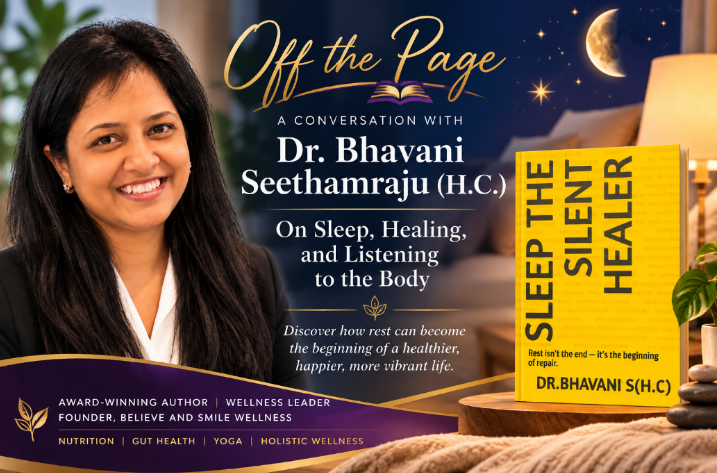
Award-winning author, wellness leader, and Believe and Smile Wellness founder Dr. Bhavani Seethamraju (H.C.) wants us to reconsider one of the most fundamental—and frequently sacrificed—parts of our well-being: sleep.
For Dr. Bhavani Seethamraju, an interest in wellness began with questions.
Why do our bodies respond the way they do? What role do our everyday choices play in the way we feel? And what can we do to become more active participants in our own well-being?
Her exploration began in 2019 and took on greater urgency during the global pandemic that followed, when conversations about physical health, emotional well-being, resilience, and self-care became part of everyday life for millions of people.
Bhavani began studying nutrition and became increasingly interested in the relationship between food and physical and emotional well-being. That curiosity led her deeper into gut health and the interconnected nature of the body's systems.
Yoga added another dimension.
Through breath, movement, and mindfulness, she found an approach to wellness that wasn't focused on a single symptom or solution, but on the relationship between body and mind.
Today, as founder of Believe and Smile Wellness, Bhavani brings those interests together in work designed to help people translate holistic wellness principles into practical everyday habits. Her background also includes professional experience in legal project management and photography—seemingly different worlds that have contributed organization, observation, and creativity to the way she approaches her work today.
She is the recipient of an Honorary Doctorate in Holistic Science and has training in natural health nutrition and diet, gut health, and yoga.
Writing became another way to share what she was learning.
Her latest book, Sleep: The Silent Healer, part of The Body Wisdom Collection, turns her attention to something every human being needs but many of us routinely sacrifice: rest.
We live in a culture that often celebrates doing more, working longer, and squeezing one more task into an already crowded day.
Sleep can become negotiable.
Bhavani would like us to reconsider that relationship.
At the heart of her book is a simple idea:
“Rest isn’t the end—it’s the beginning of repair.”
For this edition of Off the Page, Dr. Bhavani Seethamraju talks about why she chose sleep as the focus of her book, the connection between rest and productivity, what different cultures can teach us about sleep, and why she believes lasting change is more about progress than perfection.
What first sparked your interest in health and wellness, and why did you choose sleep as the focus of this book?
My interest in health and wellness grew from realizing how closely our everyday habits are connected to how we feel physically and emotionally.
Sleep especially interested me because it is something every person needs, yet it is often the first thing we sacrifice when life becomes busy.
I wanted to help readers understand that sleep is not simply a pause in the day—it is an essential part of healing and overall well-being.
Your subtitle says, “Rest isn’t the end—it’s the beginning of repair.” What does that idea mean to you?
To me, this means that when we go to sleep, the body is not simply shutting down or becoming inactive.
It is beginning important work—restoring energy, supporting the immune system, processing emotions, and helping the brain and body recover.
Rest is not the end of productivity. It is what makes healthy and sustainable productivity possible.
For someone who sees sleep as time taken away from work or family, what would you most want them to understand about rest?
I would want them to understand that rest allows us to be more present for both our work and the people we love.
When we continually sacrifice sleep, we may gain a few extra hours, but we often lose energy, patience, focus, and emotional balance.
Taking care of your sleep is not selfish. It helps you give the best of yourself to your responsibilities and relationships.
How have your studies and work in nutrition, gut health, and yoga shaped the way you write about sleep?
They taught me to look at health as an interconnected system rather than as separate issues.
What we eat, how we digest food, how we manage stress, how we breathe, and how we sleep can all influence one another.
This understanding shaped my holistic approach to the book and helped me present sleep as part of a complete lifestyle rather than as an isolated habit.
A reader particularly appreciated learning how different cultures view sleep. What did you discover while researching that surprised you or changed your own perspective?
I was fascinated by how differently cultures organize rest around their climate, work patterns, family life, and traditions.
Some cultures make space for rest within the natural rhythm of the day, while others strongly emphasize continuous productivity.
What stayed with me was the idea that there is no single perfect routine for everyone. Healthy sleep practices need to respect a person’s culture, responsibilities, environment, and individual needs.
What is one practical change from the book that a reader could try when preparing for bed?
One simple change is to create a short and consistent wind-down routine.
It does not have to be complicated. It might include dimming the lights, putting away the phone, taking a few slow breaths, or reading something calming.
Repeating the same peaceful steps each evening can gradually signal to the mind and body that it is time to slow down and prepare for sleep.
How do you hope the book speaks to someone who wants better rest but feels frustrated by advice that sounds easier than it is to follow?
I hope the book makes them feel understood rather than judged.
Advice such as “just go to bed earlier” may sound simple, but real life includes stress, caregiving, work schedules, health concerns, and many other challenges.
I want readers to begin with small, realistic changes and recognize that improving sleep is a process.
Progress matters more than perfection.
One reader described the book as helping them see sleep as a necessity rather than a luxury. What response from a reader has meant the most to you?
That response meant a great deal to me because it reflects the central purpose of the book.
We often treat rest as something we must earn after completing everything else, even though our responsibilities may never truly end.
Knowing that a reader began to see sleep as necessary self-care—not as laziness or a luxury—made me feel that the book had delivered its most important message.
What did receiving the International Impact Book Award and the Booky Award for Most Relevant Read mean to you?
Receiving these awards was deeply meaningful and encouraging.
They affirmed for me that the subject of sleep is both timely and universally relevant, and that the book’s message connected with people beyond my own personal experience.
As an author, the recognition gave me greater confidence and strengthened my commitment to writing books that make wellness knowledge approachable and useful in everyday life.
How does this book fit into The Body Wisdom Collection, and what topics would you like to explore next?
Sleep: The Silent Healer reflects the central idea behind The Body Wisdom Collection: the body is constantly communicating with us, and wellness begins when we learn to listen.
Sleep is one of the body’s most powerful forms of restoration, while nutrition and gut health reveal other ways the body supports and protects us.
In future work, I would like to continue exploring the relationship between food, emotional well-being, stress, everyday habits, and the body’s natural ability to heal.
Beyond the Book
Perhaps one of the most compelling ideas behind Sleep: The Silent Healer is also one of the simplest:
Rest is not something we have to earn.
For authors, entrepreneurs, caregivers, professionals, parents, and anyone accustomed to measuring a successful day by how much was accomplished, that idea can require a significant shift in perspective.
Dr. Bhavani's message isn't about creating a flawless bedtime routine or adding another standard we have to meet. It's about becoming more attentive to what our bodies may already be telling us.
And perhaps that's the larger wisdom behind The Body Wisdom Collection.
Sometimes taking better care of ourselves doesn't begin by doing more.
Sometimes it begins by listening.
About Dr. Bhavani Seethamraju (H.C.)
Dr. Bhavani Seethamraju (H.C.) is an award-winning author, wellness leader, and founder of Believe and Smile Wellness. She is the recipient of an Honorary Doctorate in Holistic Science and holds a Diploma in Natural Health Nutrition & Diet. She is also a graduate of a 200-hour yoga teacher training program and is certified in gut health.
Her work focuses on translating holistic wellness principles into practical daily habits, with particular interests in gut and liver health, nutrition, sleep hygiene, stress, and emotional and physical well-being.
Before focusing her work on wellness, Dr. Bhavani's varied professional background included legal project management and professional photography. Those experiences helped shape an approach that combines organization and structure with an understanding of the demands of modern life.
Through Believe and Smile Wellness and her writing, including The Body Wisdom Collection, she encourages readers to develop greater awareness of their bodies and build sustainable wellness practices into everyday life.
Her book, Sleep: The Silent Healer, explores the restorative role of sleep and invites readers to reconsider rest not as time lost, but as an important part of overall well-being.
Learn more about Dr. Bhavani Seethamraju and Believe and Smile Wellness at BelieveAndSmile.net.
Show les