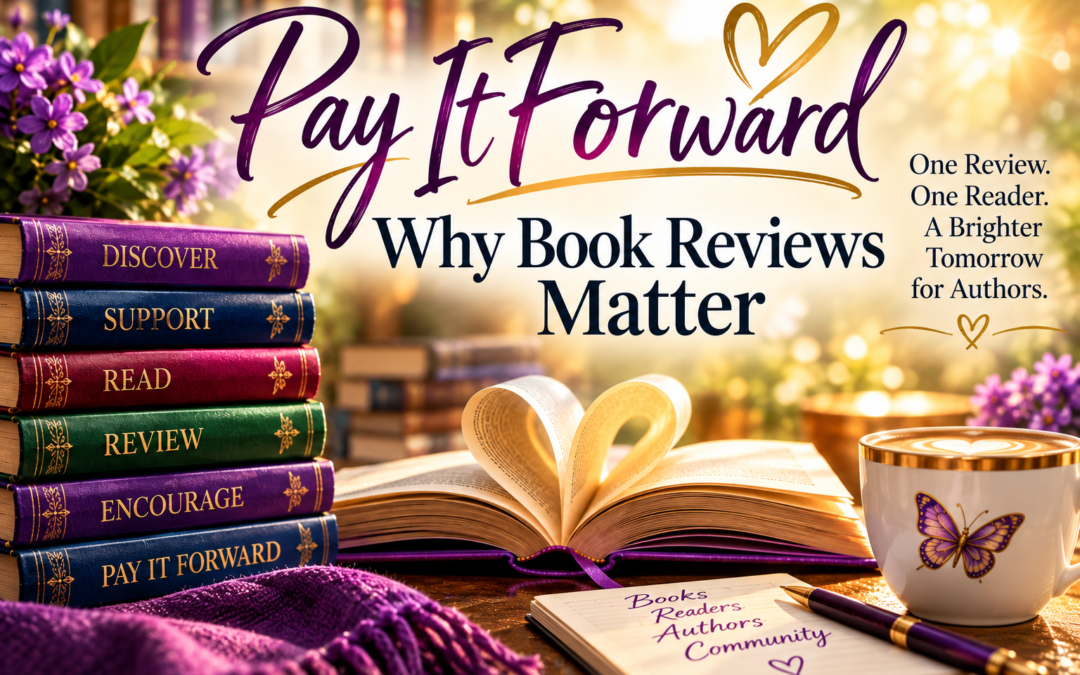
and How Authors Can Support One Another Without Trading Reviews
Building a culture of honest reviews, generous readers, and meaningful author connections.
What if one of the best ways to encourage more reviews for our own books was to stop thinking about getting reviews for a moment—and start giving them?
It's a simple idea, but one that could transform how authors support one another.
Every independent author knows the challenge. We spend months, sometimes years, writing, editing, formatting, publishing, and promoting our books. We celebrate publication day, share our books with friends and colleagues, and eagerly wait for those first reviews.
And then we wait some more.
Perhaps someone tells us they loved our book. Maybe a reader sends a wonderful email describing how much our words meant to them. A friend promises to leave a review.
But when we visit our Amazon book page, the review count hasn't changed.
Sound familiar?
I've experienced this firsthand. After giving away 37 complimentary copies of one of my books, I received just three reviews. That's approximately an 8% response rate.
The experience reminded me of something important: Reading a book and reviewing a book are two very different habits.
Most readers don't intentionally withhold reviews. They finish a book, move on to the next one, and simply forget. Some don't realize how much reviews matter. Others believe their opinions aren't important enough to share.
But for an independent author, a thoughtful review can be one of the most meaningful gifts a reader can give.
And that brings me to an idea I've been thinking about lately.
What if we stopped treating reviews as something to collect and started treating them as something to give?
Why Book Reviews Matter More Than Many Readers Realize
Book reviews serve several purposes, and their value extends far beyond a star rating.
1. Reviews help readers make decisions
Think about the last time you purchased a book by an unfamiliar author.
You probably looked at the cover, read the description, and perhaps explored the author's website. But there's a good chance you also checked the reviews.
What did other readers think? Was the book engaging? Did it deliver what it promised? Would someone with similar interests enjoy it?
A thoughtful review can answer questions that a book description cannot.
For nonfiction books, reviews may explain whether the information is practical, understandable, or useful.
For fiction, they may describe the pacing, character development, emotional impact, or storytelling style.
The best reviews help the right readers find the right books.
2. Reviews build credibility
An author can tell readers their book is wonderful. Naturally, we hope it is!
But when an independent reader shares a genuine experience, that perspective carries a different kind of credibility.
Reviews provide social proof—not a guarantee of quality, but evidence that real people have engaged with the book.
And that matters especially for emerging authors who haven't yet established a large audience.
3. Reviews contribute to discoverability
Reviews provide additional information that prospective readers can use when evaluating a book. A strong body of authentic feedback may encourage someone to explore an unfamiliar title.
However, authors should be cautious about claims that a particular number of reviews automatically triggers Amazon's recommendation system.
Amazon does not publish a simple formula guaranteeing increased visibility at 25, 50, or 100 reviews.
Reviews are valuable, but they are one part of a much larger discoverability strategy.
4. Reviews offer authors meaningful feedback
Sometimes a review reveals something an author didn't realize about their own work.
Perhaps a reader connected deeply with a minor character. Maybe a particular chapter helped someone solve a problem. Or perhaps a reviewer points out an area that could have been clearer.
Not every review will be glowing, and that's okay.
Constructive feedback can help authors grow, improve future books, and better understand their audiences.
5. Reviews remind authors that their words matter
This may be my favorite reason.
Writing can be a solitary endeavor. We spend countless hours putting words on pages without knowing whether those words will ever make a difference.
Then a review appears.
Someone tells us they laughed, cried, learned something new, felt understood, or found the courage to make a change.
Suddenly, all those solitary hours feel a little less solitary.
A review doesn't just describe a book.
Sometimes it reminds an author why they wrote it.
The Problem with Trading Book Reviews
When authors struggle to obtain reviews, it's understandable that they look for creative solutions.
One frequently suggested approach is a review exchange:
"You review my book, and I'll review yours."
At first glance, it sounds like a reasonable arrangement. Two authors helping each other. No money changes hands. Both participants presumably intend to be honest.
But there's a problem.
Reciprocal review arrangements can violate Amazon's customer review policies.
Amazon specifically prohibits positive author-to-author reviews given in exchange for positive reviews. Its broader rules also restrict compensated, incentivized, promotional, and conflict-of-interest reviews.
Even an arrangement that doesn't explicitly promise five stars can raise concerns if the participants feel obligated to review one another.
The issue isn't simply whether the review is truthful.
It's whether the reviewer is genuinely independent.
There is also a difference between offering someone a complimentary advance reading copy and requiring them to post a review.
Amazon permits authors and publishers to provide free or discounted copies of books, provided the recipient is not required to review the book and the author does not attempt to influence the review.
The guiding principle is simple: A review should be freely given, never owed.
What Does It Mean to Pay a Book Review Forward?
Instead of exchanging reviews, imagine this:
You finish a book by an author whose work you genuinely enjoyed.
You leave an honest review.
You don't contact the author asking them to return the favor.
You don't expect them to purchase your book.
You don't keep a list of who owes you a review.
You simply share your reading experience because you know it may help someone else discover a worthwhile book.
Then, when you finish another book, you do it again.
That's paying it forward.
And imagine what could happen if hundreds or thousands of authors and readers embraced that habit.
We wouldn't need complicated exchanges or promises.
We'd be creating something much more valuable: a community where reviewing books becomes a natural extension of reading them.
The Pay It Forward Reading Circle: A Better Way to Support Authors
One idea worth exploring is a Pay It Forward Reading Circle.
Unlike a review exchange group, a reading circle would focus on discovering books, connecting readers with authors, and encouraging thoughtful literary conversations.
Members could share book recommendations, discuss what they're reading, and introduce others to authors they might not otherwise discover.
There would be no assigned review partners, reciprocal obligations, or requirements to post reviews.
The emphasis would be on reading first and reviewing voluntarily.
Here's how such a community could work.
Step 1: Create a community bookshelf
Invite authors and readers to recommend books they believe deserve attention.
Include a variety of genres: historical fiction, mysteries, romance, memoir, business, leadership, personal development, children's literature, and more.
Readers could browse recommendations and choose books that genuinely interest them.
The bookshelf would be a discovery resource, not a list of books members are obligated to review.
Step 2: Encourage reading beyond familiar circles
It's natural to gravitate toward authors we already know.
But imagine deliberately discovering a debut novelist, an independent historian, a memoirist, or a nonfiction author whose subject is entirely new to you.
One of the greatest benefits of an author community is exposure to books we might never have encountered otherwise.
Reading outside our usual circles can expand our thinking, introduce new perspectives, and create unexpected connections.
Step 3: Make reviewing an invitation, not an obligation
A reading circle could encourage members to develop a regular review habit.
Perhaps readers set a personal goal of reviewing one book a month or four books during October.
But participation should never depend on leaving reviews.
No screenshots proving a review was posted. No review quotas tied to membership privileges. No author-to-author matching that creates expectations of reciprocity.
Instead, celebrate the act of reading, thoughtful discussion, and voluntary recommendations.
Step 4: Celebrate discoveries
Invite participants to share books they've enjoyed through newsletters, social media posts, discussion threads, or community spotlights.
A member might say:
"I recently discovered a wonderful historical novel set in nineteenth-century England. The author's attention to detail made me feel as though I was walking through the streets alongside the characters."
That kind of recommendation can introduce a book to new readers without creating a formal review arrangement.
Step 5: Keep the circle independent
This is especially important.
Authors may participate as readers, but the circle should not become a mechanism for obtaining Amazon reviews from people with whom they have close personal, financial, or professional relationships.
The community can encourage discovery and discussion without attempting to direct or monitor reviews on retail platforms.
When in doubt, choose the option that protects the independence of the reader's opinion.
Seven Ways Authors Can Pay It Forward
You don't need to organize a formal reading circle to make a difference.
Here are seven simple ways to begin.
1. Review books you already own. Look through your bookshelf or Kindle library. How many books have you enjoyed but never reviewed? Start there.
2. Discover one new independent author each month. Browse a genre you love and choose someone whose work genuinely interests you.
3. Share a book recommendation on social media. Tell your audience what you're reading and why it caught your attention.
4. Feature an author in your newsletter or blog. A brief author spotlight or book recommendation can introduce their work to readers who might otherwise never discover it.
5. Request independent books at your library. Many libraries accept purchase suggestions from patrons. It's a wonderful way to help books reach new audiences.
6. Talk about books in your communities. Book clubs, professional associations, online groups, and literary events offer opportunities to share recommendations and spark conversations.
7. Thank readers who support authors. Celebrate readers who recommend books, participate in discussions, and help spread the word. Recognize their generosity without tying rewards to posting reviews.
The wonderful thing about paying it forward is that no single action has to be enormous.
Small acts of literary generosity can create meaningful ripples.
How to Write a Helpful Book Review
Another challenge is that many readers don't know what to say in a review.
They may think they need to write several paragraphs, analyze literary techniques, or sound like a professional critic.
They don't.
A useful review can be three or four thoughtful sentences.
Consider answering these questions:
- What attracted you to the book?
- What did you especially enjoy or appreciate?
- What stood out about the writing, characters, ideas, or information?
- Who would you recommend the book to?
- Did the book make you think, feel, learn, or see something differently?
For example, a nonfiction review might say:
"I appreciated the author's practical approach and clear explanations. The examples made the concepts easy to understand, and I came away with several ideas I could apply immediately. I'd recommend this book to entrepreneurs looking for straightforward, actionable advice."
A fiction review might say:
"The historical setting was beautifully described, and I found myself completely immersed in the characters' lives. I especially enjoyed the attention to everyday details that made the period feel authentic. A wonderful choice for readers who enjoy character-driven historical fiction."
Neither review needs to be lengthy to be helpful.
And neither promises that every reader will have the same experience.
An honest review is not a sales pitch. It's a reader sharing an experience with another reader.
Do Reviews Have to Be Five Stars?
Absolutely not.
One of the most important aspects of a healthy review culture is respecting honest opinions.
A four-star review may be incredibly useful. A thoughtful three-star review can help readers determine whether a book suits their interests.
Not every book is for every reader.
A novel with a slow, reflective pace might delight one person and frustrate another. A detailed business book might be perfect for an experienced entrepreneur but overwhelming for a beginner.
Both reactions can be legitimate.
The purpose of reviewing isn't to manufacture universal praise.
It's to help readers make informed choices.
Authors who embrace honest feedback build a stronger foundation of trust than those who pursue ratings alone.
What About Advance Reader Copies?
Advance reader copies, commonly called ARCs, are an established part of book publishing.
Authors and publishers provide early copies of books to interested readers, reviewers, or media contacts.
The purpose is to introduce the book before or around publication and invite independent feedback.
Amazon permits reviews of complimentary advance copies of books, but there are important boundaries.
Authors should never require a review as a condition of receiving a copy, request a particular rating, or promise future benefits in exchange for reviewing.
A simple invitation might read:
"If you'd enjoy reading an advance copy of my book, I'd be happy to share one. There is absolutely no obligation to leave a review. If you independently choose to share your honest thoughts, I would appreciate it."
Readers should also follow any applicable disclosure requirements and the policies of the platform where they publish their reviews.
The goal is not to control the outcome.
It's to give interested readers an opportunity to discover the book.
From Pay It Forward to STAR Month™
This philosophy is one of the reasons I launched STAR Month™, an annual October initiative celebrating readers who support authors through honest book reviews.
STAR stands for:
S — Support an Author
T — Take Time to Read
A — Appreciate the Written Word
R — Review Honestly
The STAR Pledge invites readers to leave at least four honest book reviews during October.
Not four positive reviews.
Not four reviews for friends.
Not four reviews in exchange for receiving reviews of their own books.
Four independent, honest reviews of books they've chosen to read.
The initiative is built around a simple belief: when more readers make reviewing a regular habit, more authors benefit.
And while October provides a wonderful opportunity to celebrate that habit, there's no reason to stop when the month ends.
Imagine carrying that spirit into November, December, and throughout the year.
A 30-Day Pay It Forward Challenge
Want to make this idea part of your reading routine?
Try this simple four-week challenge.
Week One: Rediscover
Look through your recent reads and identify a book you enjoyed but haven't reviewed. If you're eligible and have no conflict of interest, write an honest review on your preferred platform.
Week Two: Discover
Find an independent author whose book genuinely interests you. Add it to your reading list or begin reading.
Week Three: Share
Recommend a book to someone who might enjoy it. Share a thoughtful social media post, mention it in a newsletter, or introduce it during a book club conversation.
Week Four: Inspire
Invite another reader to develop the habit of reviewing books. Explain how even a short, sincere review can help others discover worthwhile titles.
That's it.
No exchanges.
No complicated tracking.
No expectations of repayment.
Just four weeks of meaningful literary generosity.
The Ripple Effect of One Review
Imagine a reader discovers an unfamiliar book because of your recommendation.
They read it, enjoy it, and tell a friend.
That friend shares it with a book club.
Someone in the book club purchases another title by the same author.
Perhaps one of those readers eventually writes a review that introduces the book to an entirely new audience.
We can't predict or guarantee that chain of events.
But we can create opportunities for it to happen.
And that is what makes paying it forward so meaningful.
When we recommend a book or share an honest review, we're doing more than supporting an individual author.
We're helping stories, ideas, knowledge, and creativity travel farther.
We're contributing to a literary ecosystem in which discovery doesn't depend entirely on advertising budgets, celebrity endorsements, or established publishing connections.
We're reminding readers that their voices matter, too.
A Final Thought: Be the Reader You Hope to Find
As authors, we spend considerable time thinking about how to attract readers, build audiences, and encourage reviews.
Those are worthwhile goals.
But perhaps we should also ask ourselves a different question:
Am I being the kind of reader I hope will discover my own books?
Do I take time to acknowledge books that move me?
Do I recommend authors whose work deserves attention?
Do I leave thoughtful reviews when I have something meaningful to share?
Do I celebrate other writers without expecting something in return?
The answers may reveal opportunities to make a difference.
I believe the independent author community is strongest when collaboration is grounded in generosity rather than obligation.
We don't need to trade reviews to support one another.
We can read one another's work when it genuinely interests us, recommend books we believe in, and share honest opinions without expecting repayment.
And perhaps, somewhere along the way, someone will discover one of our books and feel inspired to do the same.
Because the most meaningful review isn't the one someone owes us. It's the one they freely choose to give.
Join the Conversation
I'd love to hear from fellow authors and readers:
Would you participate in a Pay It Forward Reading Circle?
How do you discover independent authors? Do you regularly leave book reviews? And what would encourage you to make reviewing a more consistent part of your reading life?
Share your thoughts and ideas.
Together, we can create a culture where more readers discover great books, more authors feel appreciated, and honest reviews become a natural part of the reading experience.
More Readers. More Impact. Together.
Heidi Richards Mooney is the founder of The Author Collab and creator of STAR Month™, an initiative encouraging readers to support authors through honest book reviews and meaningful literary engagement.
Additional Resources
For authors interested in understanding review policies and building ethical review practices:
Review policies can change. Always consult the current requirements of the platform where a review will be published.