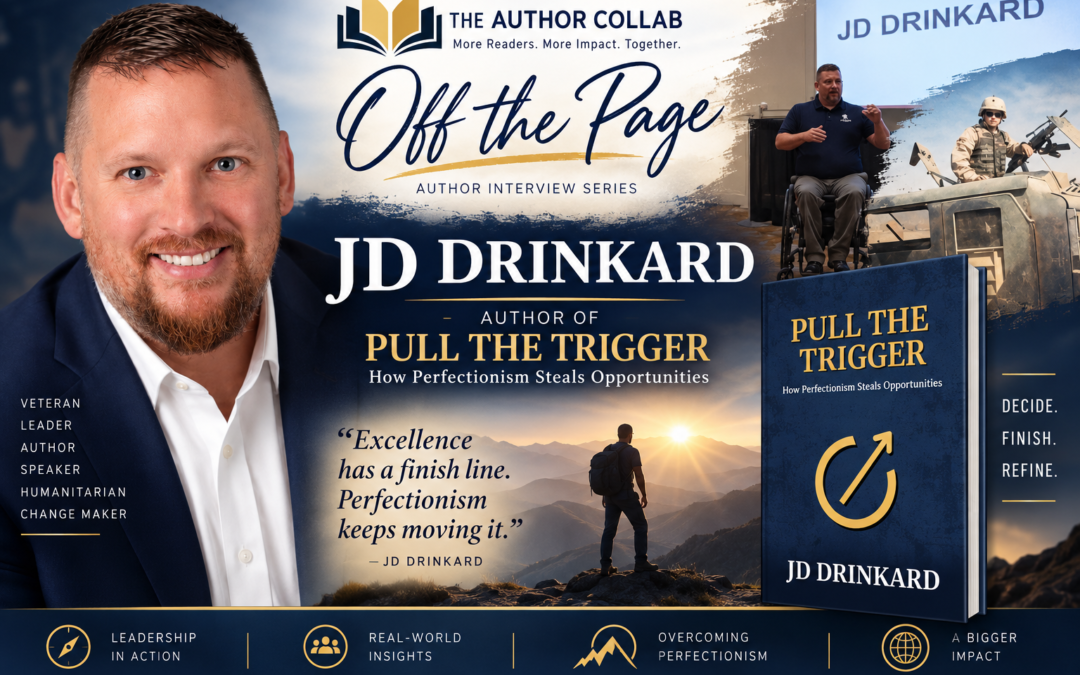
The author of Pull the Trigger: How Perfectionism Steals Opportunities on disciplined action, leadership, the hidden cost of unfinished work—and why some opportunities can only find us after we finish.
Some books begin with an idea. Others begin with a lesson the author has had to learn personally.
For JD Drinkard, Pull the Trigger: How Perfectionism Steals Opportunities grew from recognizing a pattern he had seen throughout his career—and eventually in himself.
Capable, responsible people can spend so much time preparing, refining, researching, and waiting for certainty that the opportunity they were preparing for begins to pass them by.
JD knows something about preparation and decision-making under pressure.
An author, speaker, leadership strategist, retired U.S. Army Sergeant First Class, and Iraq combat veteran, JD has built a career around helping people move from intention to disciplined execution. His perspective has been shaped by military service, business, nonprofit leadership, entrepreneurship, and international humanitarian work.
He is the founder and CEO of International Leadership Solutions, where he works with leaders and organizations to strengthen decision-making, execution, leadership systems, and sustainable performance. He also serves as Executive Director of the Mighty Warrior Foundation, supporting efforts that strengthen purpose, development, and opportunity for veterans.
JD was also one of the inaugural participating authors in The Author Collab Book Blast, making it especially meaningful to welcome him back to The Author Collab—this time to take us Off the Page and into the story, experiences, and thinking behind his work.
About Pull the Trigger
Pull the Trigger: How Perfectionism Steals Opportunities is a practical leadership and execution book for capable people who find themselves caught somewhere between preparation and action.
JD examines how perfectionism, overthinking, excessive refinement, and the desire for certainty can quietly delay meaningful work until opportunities begin to disappear.
Through concepts including the Completion Method, the 70% Completion Rule, the Completion Threshold, and the Opportunity Window, readers learn how to distinguish responsible preparation from fear-driven delay.
At the center of the book is a deceptively simple framework:
Decide. Finish. Refine.
The goal isn't to abandon high standards. It is to make sure those high standards eventually produce something.
And JD's own experience with this book offers compelling proof of what can happen once we finally finish.
Proceeds from Pull the Trigger helped fully fund a poultry farm in Uganda designed to create sustainable income and local opportunity—an outcome JD could never have predicted while the manuscript was still sitting unfinished on his computer.
As JD discovered, unfinished work has a cost we don't always consider:
It cannot serve anyone.
That seems like the perfect place to begin our conversation.
JD, Pull the Trigger has a title that immediately suggests action. What inspired you to write this book, and when did you first recognize that perfectionism can keep capable people from pursuing opportunities that are right in front of them?
I think I recognized the pattern long before I had a name for it. Throughout my career, I had been around incredibly capable people who were willing to work hard, prepare, and take responsibility, but sometimes the very traits that made them successful also made it difficult to finish.
We tell ourselves we are being thorough, responsible, or committed to excellence, when sometimes we are really trying to eliminate the possibility of criticism, failure, or uncertainty.
Eventually I had to recognize that pattern in myself.
I had ideas and projects that stayed unfinished much longer than they should have because I kept believing they needed something else. Another revision. More research. More certainty. A little more time.
Pull the Trigger itself became one of those projects.
At some point, I had to stop asking whether the manuscript was perfect and start asking whether it was strong enough to accomplish its purpose and help someone.
That distinction became the foundation of the book.
The real danger of perfectionism is that it rarely announces itself as fear. It usually sounds responsible. It tells capable people, "You're almost ready."
The problem is that opportunities have a window. There is a point where additional preparation stops increasing your readiness and starts increasing the cost of waiting.
I wrote Pull the Trigger for people living in that space. They are not lazy or unmotivated. Many of them are highly capable people who have prepared extensively.
What they need is not another reason to prepare. They need a responsible way to recognize when preparation has done its job and it is time to act.
"The real danger of perfectionism is that it rarely announces itself as fear. It usually sounds responsible."
You served as a Sergeant First Class in the U.S. Army/Alabama Army National Guard, where preparation, discipline, and precision can be incredibly important. How did your military experience shape your ideas about the difference between being well-prepared and waiting for everything to be perfect?
The military taught me to respect preparation, not worship certainty.
Preparation matters because the consequences of being unprepared can be significant. You train, rehearse, develop contingencies, understand the mission, assess risk, and make sure the people around you know what they are responsible for. None of that is optional.
But military leadership also teaches you very quickly that the environment is not going to cooperate with your plan.
Information changes. Conditions change. People react differently than expected. Equipment fails. The situation you prepared for may not be the situation you actually encounter.
Eventually, someone still has to make a decision.
That shaped an important distinction for me. Preparation should increase your ability to act responsibly under uncertainty. If preparation becomes an attempt to eliminate uncertainty altogether, you can prepare forever.
That is one of the ideas behind the 70% Completion Rule in Pull the Trigger. It is not permission to be careless, and it never overrides legal, ethical, safety, or mission-critical requirements.
It is a recognition that there is often a point where you possess enough information, preparation, and capability to move responsibly, and additional preparation is producing diminishing returns.
Leadership requires judgment in the remaining uncertainty.
The military taught me that a good leader does not wait for perfect conditions. A good leader prepares the team, understands the mission, considers the risks, makes the best decision possible with the information available, communicates clearly, and remains prepared to adjust when reality provides new information.
That is very different from recklessness.
It is disciplined action.
"The military taught me to respect preparation, not worship certainty."
The phrase "pull the trigger" can represent that critical moment when we stop preparing, second-guessing, or waiting and finally act. How do you know when you've done enough preparation and it's time to move forward, even when you don't have every answer?
I think you have to define what "ready" means before your emotions get a vote.
One of the problems with perfectionism is that the finish line keeps moving. If your standard is simply, "I'll move when I feel completely confident," you may never move. There will almost always be another question you could ask or another improvement you could make.
Instead, I encourage people to establish a completion threshold.
What is this decision or project supposed to accomplish? What are the essential requirements? Have the material risks been considered? Have the appropriate legal, ethical, financial, or safety obligations been addressed? Is there a significant piece of information still missing that could materially change the decision?
Then ask another question:
Is the next round of preparation likely to improve the outcome, or is it mainly going to make me feel more comfortable?
That is an important distinction.
The 70% Completion Rule represents the point where responsible readiness has been reached and action begins producing more value than continued preparation. The number is not an excuse to submit 70% quality work. It is a decision threshold.
You have enough clarity to decide, enough readiness to move, and enough refinement to finish responsibly.
The remaining uncertainty is often where leadership actually happens.
You learn some things only by moving. Customers react. Teams respond. Readers give feedback. The market changes. The plan encounters reality.
Action gives you evidence that preparation alone cannot provide.
That is why the central process in the revised edition is Decide. Finish. Refine.
Decide what the work must accomplish. Finish the strongest responsible version capable of accomplishing it. Then refine through evidence rather than trying to predict every possible outcome before you begin.
Through International Leadership Solutions, you work with executives, organizations, and teams facing complex leadership challenges. Where do you see perfectionism showing up most often in leaders, and what opportunities can it cost them and their organizations?
One of the most common places I see it is in decision-making.
Leaders often believe perfectionism will look like someone obsessing over a tiny detail, but organizational perfectionism can be much more sophisticated.
It can look like another meeting, another round of research, another version of the proposal, another stakeholder who needs to be consulted, or another data point someone wants before they are willing to commit.
Sometimes those things are necessary.
Sometimes they are hesitation wearing professional clothing.
The cost extends beyond the individual leader. When the person responsible for direction continues reconsidering a decision, the entire organization begins to slow down.
Team members become less confident about what they should prioritize. People hesitate to take initiative because they are waiting to see whether the direction will change again. Opportunities sit in pipelines. Projects remain in draft form. Customers wait. Good ideas lose relevance.
The leader's hesitation eventually becomes the organization's rhythm.
I also see perfectionism when leaders confuse control with responsibility. They try to personally anticipate every problem before allowing the team to move. That can create bottlenecks and teach capable people that initiative is risky.
I believe completion is a leadership competency because teams experience leadership through follow-through. They need to see decisions become direction, plans become execution, and commitments become completed work.
The goal is not to lower standards. The goal is to make sure high standards actually produce something.
A strong plan delivered while it can still create value will often accomplish more than a flawless plan delivered after the opportunity has passed.
"The goal is not to lower standards. The goal is to make sure high standards actually produce something."
Your career has taken you through military service, business consulting, nonprofit leadership, humanitarian work, and international operations. Was there a particular experience when you had to make an important decision without having perfect information, and what did that experience teach you?
There have been many situations throughout military and international work where complete information simply was not available, but one of the experiences that became especially important to this book was much less dramatic:
Deciding to publish the book itself.
I had to decide whether the manuscript was strong enough to serve someone even though I knew I could continue improving it.
That sounds simple compared with decisions made in combat or difficult humanitarian environments, but it exposed something important.
When your work becomes personal, uncertainty feels different.
Publishing meant the work would no longer belong only to me. Other people could evaluate it, criticize it, misunderstand it, or identify something I could have done better.
I eventually realized that many of the questions I was trying to answer could only be answered after the book existed in the world.
So I published it.
That decision produced evidence I could never have created while the manuscript remained on my computer. Readers told me what connected with them. Speaking opportunities followed. The ideas became part of conversations with leaders and organizations.
I could see where the framework was strong and where it could be made more useful.
Then I revised the book based on evidence rather than imagination.
That experience reinforced one of the most important principles I teach now:
Completion is not the opposite of improvement. Completion makes informed improvement possible.
Sometimes the answer you are waiting for exists on the other side of action.
Perfectionism is often disguised as something positive: high standards, preparation, responsibility, or wanting to get things right. How can someone recognize when excellence has crossed the line into perfectionism that is actually holding them back?
One of the simplest distinctions I make in the book is this:
Excellence has a finish line. Perfectionism keeps moving it.
Excellence asks, "What does this work need to accomplish?"
Perfectionism asks, "How do I make sure nobody can find anything wrong with it?"
Those questions create very different behaviors.
Excellence strengthens the work. It welcomes preparation, discipline, standards, review, and refinement. But those things are attached to a purpose.
Once the work meets the responsible standard required by the mission, excellence allows the work to move forward.
Perfectionism becomes attached to perception. The revisions stop being about whether the work is useful or effective and start becoming about whether we can protect ourselves from criticism or discomfort.
There are several warning signs.
You keep making changes but cannot explain the measurable value they add. You continue collecting information even though none of it is changing your decision. You repeatedly revisit choices you have already made. Your deadline keeps moving even though no material requirement has changed.
Or you realize that the real reason you have not released the work is simply that you are uncomfortable with someone else seeing it.
That last one matters.
Visibility creates vulnerability.
Once the work is finished, it can be evaluated. Perfectionism tries to protect us from that moment.
Excellence eventually delivers.
If someone reading Pull the Trigger has been sitting on an idea, opportunity, career move, business, book, or dream because they don't feel completely ready, what do you hope they will believe—and, more importantly, do—after reading your book?
I hope they stop treating readiness as a feeling they have to wait for.
You may never feel completely ready for something that matters. Fear may still be there. Doubt may still be there. There may still be questions you cannot answer.
That does not automatically mean you are unprepared.
I want readers to believe that they can trust the work they have already done, the experience they have already gained, and the judgment they have developed.
They do not need the entire path revealed before taking the next responsible step.
More importantly, I want them to identify something real.
Not someday. Not the dream in the abstract.
What is one decision, project, application, conversation, manuscript, proposal, business idea, or responsibility that has remained "almost ready" for too long?
Define what finished actually means. Identify what must be true for it to move forward responsibly. Separate the necessary work from the work you are doing only because finishing makes you uncomfortable.
Then complete the next meaningful action.
Send the application.
Have the conversation.
Submit the proposal.
Publish the work.
Schedule the meeting.
Make the decision.
You do not have to transform your entire life in one dramatic moment. You need evidence that you can trust yourself to finish.
Completion creates that evidence.
My hope is that readers close the book understanding that their best opportunities are probably not waiting for them to become perfect.
They are waiting for them to finish.
Off the Page: One More Thing
There is one part of JD's story that seems particularly appropriate for The Author Collab because it demonstrates something we believe deeply: we don't always know how far our words will travel once we release them into the world.
Proceeds from Pull the Trigger helped fully fund a poultry farm in Uganda designed to create sustainable income and local opportunity.
When JD's manuscript was sitting unfinished on his computer, he couldn't have predicted that.
He couldn't know every conversation the book would create, every reader it might reach, every speaking opportunity that might follow—or that something he had almost allowed perfectionism to keep in draft form would eventually help create something tangible on another continent.
As JD puts it:
"Potential is valuable, but potential held privately cannot create much impact. Completion gives an idea the opportunity to become useful."
Perhaps that is the most fitting takeaway from our conversation.
We spend a great deal of time wondering what might happen if we put our work into the world.
Sometimes we need to ask a different question:
What might never happen if we don't?
About JD Drinkard
JD Drinkard, MBA, is an author, speaker, leadership strategist, retired U.S. Army Sergeant First Class, and Iraq combat veteran whose work focuses on helping leaders move from intention to disciplined execution.
He is the founder and CEO of International Leadership Solutions, where he works with leaders and organizations to strengthen decision-making, execution, leadership systems, and sustainable performance.
JD's approach to leadership has been shaped by military service, business, nonprofit leadership, entrepreneurship, and international humanitarian work. He also serves as Executive Director of the Mighty Warrior Foundation, supporting efforts that strengthen purpose, development, and opportunity for veterans.
He earned his MBA from The University of Alabama. His experiences with combat, injury, loss, recovery, leadership, and rebuilding have reinforced a principle that runs throughout his work: meaningful leadership does not require perfect circumstances, but it does require the willingness to act responsibly when the mission demands it.
He is the author of Pull the Trigger: How Perfectionism Steals Opportunities and continues to write, speak, and develop practical leadership frameworks for people committed to doing work that matters.
Connect with JD
Author, books, speaking & leadership resources: jddrinkard.com
International Leadership Solutions: internationalleadershipsolutions.com
LinkedIn: linkedin.com/in/jd-drinkard
Facebook: facebook.com/jddrinkardofficial
Instagram: @jddrinkardofficial
About Off the Page
Off the Page is an Author Collab interview series that goes beyond the book to discover the experiences, ideas, challenges, and defining moments behind the authors who write them.
Because sometimes the most interesting story isn't only what's written on the page.
It's what happened before—and what happens next.