Why unfinished manuscripts aren't necessarily failed projects—and how to know when it's time to begin again
Every writer has a story about a book they intended to finish.
Perhaps it's a novel sitting in a folder on their computer, a nonfiction manuscript with seven completed chapters, or a collection of poems waiting for the right moment to become a book.
Sometimes we stop because the ideas aren't coming. Sometimes another project captures our attention. And sometimes life intervenes in ways we could never have anticipated.
A career change. A health crisis. A family responsibility. The loss of someone we love.
Suddenly, the manuscript that once occupied our thoughts every day becomes something we promise ourselves we'll return to someday.
And someday can turn into months, years, or even decades.
But here's something I've learned:
An unfinished manuscript isn't necessarily a failed manuscript. Sometimes it's simply a project waiting for a different season of our lives.
When Writing Has to Wait
In 2007, my daughter Alexis passed away at twenty-seven.
Her death changed almost everything about my life. I stepped away from speaking, traveling, networking, and leadership positions. I continued running my businesses, but many of the creative projects that had once filled my days came to a stop.
Among them were two books I had been working on: 100+ Rules for Writers and The Ninth Law.
For a long time, I had neither the energy nor the desire to return to them.
I learned something during those years that I have never forgotten:
Grief can't wait. Writing can.
There are seasons when finishing a manuscript simply isn't the most important thing we need to do.
And that's okay.
We sometimes talk about writing discipline as though the answer to every challenge is to push harder, write more consistently, or refuse to let anything interrupt our progress.
But discipline also requires discernment.
Knowing when to continue is important. Knowing when to pause can be just as valuable.
There is a passage in Ecclesiastes that reminds us:
"To every thing there is a season, and a time to every purpose under the heaven." — Ecclesiastes 3:1 (KJV)
For writers, perhaps that includes a season for creating, a season for gathering experiences, and a season for returning to the words we've left behind.
The Unexpected Value of Stepping Away
When we think about improving our writing, we often focus on the obvious skills: storytelling, grammar, structure, editing, research, and developing a distinctive voice.
But some of the most valuable lessons we learn as writers happen when we're not writing at all.
During my own extended pause, I journaled more. I became a better listener and a more attentive observer. I began noticing the emotions beneath conversations, the details in ordinary experiences, and the ways people reveal themselves through what they say—and what they leave unsaid.
Those experiences eventually influenced the way I approached my writing.
I returned with different perspectives, new insights, and a greater appreciation for the power of words.
Of course, not every pause leads to a creative breakthrough. Some experiences simply require our time, energy, and attention. We don't need to turn every hardship into a writing lesson to justify stepping away.
But sometimes, when we eventually return to our manuscripts, we discover that we've changed.
And because we've changed, our writing changes too.
The Assignment That Brought Me Back
Earlier this year, I joined several writers' groups to reconnect with my writing and the author community.
One group gave us an assignment that seemed relatively simple:
Look back at the projects you've started but never completed. Decide which ones you still want to finish—and which ones you're ready to let go.
That assignment prompted me to revisit manuscripts I had set aside nearly twenty years earlier.
I opened old files, reread notes, and considered whether those ideas still mattered to me.
Some did. Others didn't.
And that distinction was important.
We don't have to finish every project simply because we started it. Sometimes an idea has served its purpose. Sometimes we've outgrown it. And sometimes another project deserves our attention more.
But when I revisited 100+ Rules for Writers and The Ninth Law, I realized I still wanted to bring those books into the world.
I made the decision to complete them.
In October 2026, 100+ Rules for Writers: From the Writers Who Wrote the Books was published. The Ninth Law is in its final stages, with publication anticipated in December or January.
Another long-unfinished project has also been completed.
The manuscripts had waited nearly two decades.
And when I returned to them, I brought nearly two decades of additional experiences, insights, and lessons to the pages.
Some Manuscripts Wait Decades to Find Their Readers
My experience isn't unique. Literary history is filled with manuscripts that took unexpected journeys before reaching readers.
Harper Lee's Go Set a Watchman was written in the 1950s, before To Kill a Mockingbird, but wasn't published until 2015. The manuscript had been set aside for more than half a century. Its eventual publication also sparked questions about whether every rediscovered manuscript should be published.
J. R. R. Tolkien spent decades developing the stories that would become The Silmarillion. He never completed a definitive version during his lifetime. After his death, his son Christopher assembled and edited the material, bringing the book to readers in 1977.
And then there's John Kennedy Toole's A Confederacy of Dunces. Although the manuscript was completed, it remained unpublished during his lifetime. His mother's determination eventually helped bring it into print in 1980, eleven years after his death. The novel won the Pulitzer Prize for Fiction the following year.
These stories are different. Some manuscripts were unfinished, others unpublished, and some required another person's involvement to reach readers.
But they share an important reminder: The path from first draft to published book isn't always a straight line.
Of course, not every unfinished manuscript is destined to become a literary classic. Nor does every project need to be completed.
Sometimes the greatest value of revisiting an old manuscript isn't discovering a masterpiece. It's discovering whether the idea still matters to us—and whether we're ready to give it another chance.
Five Questions to Ask Before Returning to an Unfinished Manuscript
If you have a writing project waiting in a folder, on a shelf, or somewhere in the back of your mind, perhaps it's time to take another look.
Not necessarily to finish it immediately, but to decide whether it still has a place in your creative life.
Here are five questions that can help.
1. Does this story or idea still matter to me?
The excitement that inspired a project years ago may have faded. That's natural.
But sometimes, beneath the unfinished chapters and outdated notes, there's still an idea that deserves to be explored.
Ask yourself whether the central message, story, or purpose continues to resonate with you.
If it does, that may be reason enough to revisit it.
2. Am I still the right person to write this book?
This might seem like an unusual question, but consider how much you've changed since you first began.
You may have developed new expertise, experienced significant life events, or gained perspectives you didn't have before.
Perhaps you're now better equipped to write the book than you were when you started.
Or perhaps your experiences have led you toward an entirely different story.
Both discoveries have value.
3. What would I change if I started today?
Don't assume you have to preserve every chapter, character, or idea from the original manuscript.
Give yourself permission to reconsider the structure, update the examples, change the direction, or even begin again.
For nonfiction authors, this may mean refreshing research, replacing outdated references, or incorporating new professional experiences.
For fiction writers, it might mean developing characters more fully, strengthening the plot, or discovering a different ending.
The original manuscript is a starting point, not a contract.
4. What's really preventing me from finishing?
Sometimes the obstacle is practical: limited time, competing responsibilities, or a lack of resources.
Other times, it may be uncertainty, perfectionism, fear of criticism, or simply not knowing what comes next.
And sometimes the answer is that we're not ready.
Understanding the reason can help us decide whether to move forward, seek support, or give ourselves more time.
There is no universal deadline for returning to a creative project.
5. What would finishing look like now?
The book you imagined years ago may not be the book you want to publish today.
Perhaps a full-length manuscript would work better as a shorter guide, a series of articles, or a collection of essays.
Perhaps the audience has changed.
Perhaps the message has become clearer.
Instead of asking, "How do I finish the book I started?" consider asking:
"What does this project have the potential to become today?"
That question may open possibilities you hadn't previously considered.
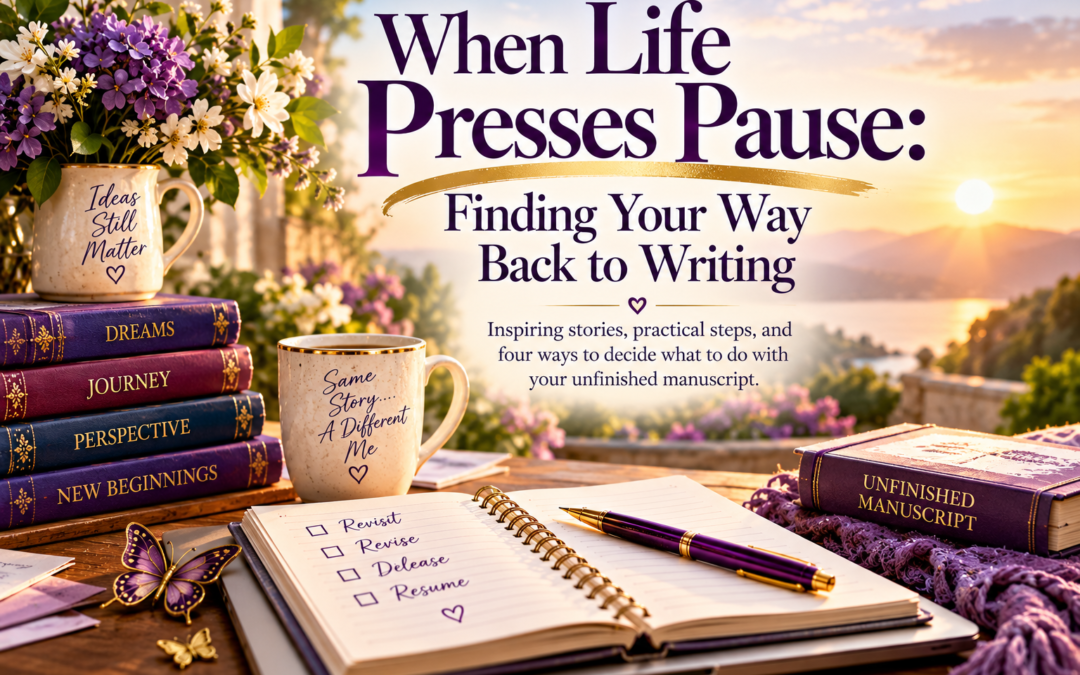
A Simple Exercise: Revisit, Revise, Release, or Resume
Here's an exercise you can complete in less than an hour—or take as much time as you need.
Gather a list of unfinished writing projects. Include books, articles, stories, essays, workbooks, or ideas you've been meaning to develop.
For each project, choose one of four paths.
REVISIT — Explore the possibility.
The idea still interests you, but you're not ready to commit. Reread the material, review your notes, and consider what the project might become.
REVISE — Give it a new direction.
The original concept needs updating, restructuring, or reimagining. Identify what still works and what you would change.
RELEASE — Let it go.
The project no longer reflects your interests, goals, or priorities. Give yourself permission to set it aside without guilt. You can archive it rather than delete it.
RESUME — Begin again.
The project still matters, and you're ready to move forward. Choose one small, specific action that will help you restart.
That action might be rereading the first chapter, revising the outline, updating your research, or scheduling thirty minutes to write.
You don't have to finish the entire manuscript this week.
You only have to decide what comes next.
When You Return, Don't Expect to Be the Same Writer
One of the most interesting things about revisiting old manuscripts is discovering how much we've changed.
The writing may feel unfamiliar. The ideas may seem incomplete. You may wonder why you approached certain subjects the way you did.
Resist the temptation to criticize the writer you were.
That earlier version of you did the best they could with the knowledge, experience, and perspective they had at the time.
Instead, appreciate what they began.
Then consider what the writer you've become can contribute.
Perhaps you've developed a stronger voice. Perhaps you're more confident about what you want to say. Perhaps you've learned to listen more carefully, observe more closely, or trust your instincts.
Or perhaps you've simply discovered that your priorities have changed.
Growth doesn't always mean producing more. Sometimes it means understanding more deeply what deserves your attention.
The Difference Between Pausing and Quitting
Writers can be remarkably hard on themselves.
We celebrate completed manuscripts, publication announcements, and impressive word counts. But we rarely celebrate the courage it sometimes takes to step away.
Not every pause is procrastination.
Not every unfinished project represents a lack of discipline.
And not every book needs to be written on the schedule we originally imagined.
Sometimes the most responsible decision we can make is to give our attention to the people, responsibilities, or circumstances that need us most.
Writing will still be there when we're ready to return.
And if we decide not to return to a particular project, that doesn't diminish the value of what we learned while working on it.
We are more than the books we finish. We are also the lives we live between the pages.
Your Story Isn't Over
Nearly twenty years ago, I put aside manuscripts I wasn't ready to finish.
This year, I returned to them.
The pages were still there, but I was no longer the same writer.
I had experienced more, learned more, listened more, and discovered things about myself that I couldn't have anticipated when I began.
Would those books have been different if I'd finished them earlier? Certainly.
Would they have been better or worse? I'll never know.
But they are the books I am ready to share now.
And that is enough.
So if you have an unfinished manuscript waiting somewhere, don't automatically assume you've failed it.
Perhaps it's time to revisit it.
Perhaps it's time to let it go.
Or perhaps it's simply waiting for another season.
Sometimes a pause isn't the end of the story. Sometimes it's part of the story we haven't yet learned how to tell.
— Heidi Richards Mooney
Let's Talk About It
Have you ever put a writing project on hold because life took an unexpected turn?
Did you eventually return to it? Did you discover a new direction? Or did you decide that letting it go was the right choice?
Share your experience in the comments. Your story might be exactly what another writer needs to hear today.
For readers interested in the personal experience behind this article, I've shared a more intimate reflection on grief, my daughter Alexis, and the manuscripts I set aside for nearly two decades on HeidiRichards.com: "Grief Can't Wait. Writing Can: The Stories I Put on Hold—and the Life That Happened in Between."