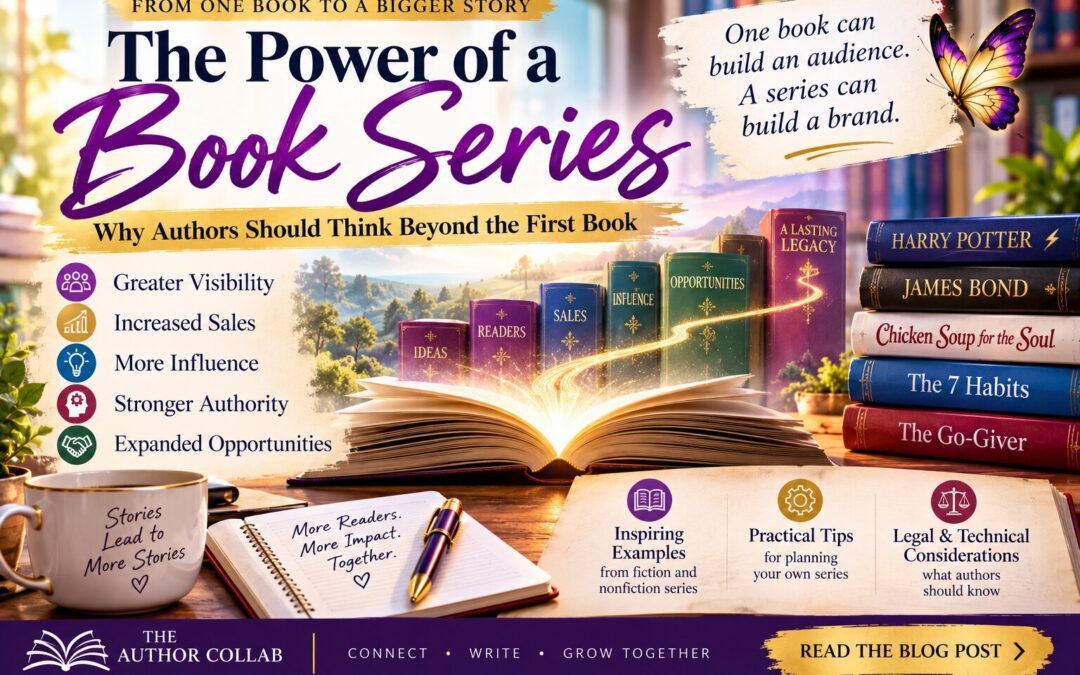
Why Authors Should Think Beyond the First Book
Writers spend so much time trying to finish the book that we don't always stop to ask an intriguing question:
What if this isn't one book? What if it's the beginning of something bigger?
That question has been on my mind recently as I prepared 100+ Rules for Writers: From the Writers Who Wrote the Books for publication. When I uploaded the Kindle edition, Amazon asked whether the book was part of a series.
My answer was yes.
It is now part of The Author Collab Series, which gives me room to explore other aspects of the author journey in future books.
That simple little question on a publishing form reminded me how powerful a series can be.
A series isn't only a fiction strategy. And it isn't simply a way to sell the reader another book.
Done well, a series can become an author's ecosystem.
The Power of “What Comes Next?”
One of the greatest advantages of a series is something every author wants:
A reader who finishes one book already knows what to read next.
For a novelist, that might mean following a beloved character into another adventure.
For a nonfiction author, it might mean taking the reader to the next stage of a transformation.
Instead of having to introduce yourself to a brand-new audience every time you publish, you're building upon a relationship that already exists.
The first book can sell the second.
The second can send readers back to the first.
The third can strengthen the entire collection.
Your backlist begins working as a team instead of as a group of unrelated books.
That can mean more opportunities for cross-promotion, boxed sets or bundles where appropriate, advertising, special promotions and continuing reader engagement.
It can also make the author's answer to “What should I write next?” considerably easier.
Fiction Has Been Teaching Us This for Years
Some of publishing's most recognizable properties demonstrate the extraordinary power of continuing a story readers don't want to leave.
J.K. Rowling mapped out the seven-book Harry Potter series before completing it. The books have since sold more than 600 million copies worldwide in 85 languages. J.K. Rowling
The lesson isn't that every author should plan seven novels or expect Harry Potter numbers.
The lesson is that each successful installment can increase the value and visibility of the books surrounding it.
Ian Fleming created another enduring example with James Bond. Beginning with Casino Royale in 1953, Fleming's Bond bibliography ultimately included twelve novels and two story collections, and the Bond literary universe continued beyond Fleming's original works. Ian Fleming
A recurring character became much more than the protagonist of one novel.
He became an identifiable literary property.
Nonfiction Authors Can Do It Too
This is where I think independent authors sometimes miss an enormous opportunity.
A series doesn't require continuing characters. It can continue an idea.
Consider Chicken Soup for the Soul. What began with one collection became a publishing framework capable of embracing relationships, pets, grief, family, aging, resilience, holidays and countless other subjects while maintaining a recognizable promise to the reader. Today the publisher reports more than 300 titles, more than 100 million books sold in the U.S. and Canada, and translations into more than 40 languages. Chicken Soup for the Soul
That's not simply a collection of books.
That's a recognizable publishing brand.
Stephen R. Covey provides another interesting model. The 7 Habits of Highly Effective People established an organizing idea that could later be applied to other audiences and contexts, including The 7 Habits of Highly Effective Families. FranklinCovey reports that Covey's books collectively have sold more than 40 million copies in 50 languages. FranklinCovey
The concept became expandable.
And then there's a series particularly close to the Author Collab community: Bob Burg and John David Mann's The Go-Giver.
The original business parable established the central Go-Giver philosophy. The authors subsequently explored that idea through Go-Givers Sell More, The Go-Giver Leader and The Go-Giver Influencer, among other related works. John David Mann has described how they applied the original idea to sales, leadership, education and eventually influence. John David Mann
That's an important lesson for nonfiction writers:
You don't necessarily need another big idea. Sometimes you need to look more deeply at the big idea you already have.
A Series Can Increase Visibility
Every new book creates another doorway through which someone can discover you.
Imagine that Book Three is the first title a reader encounters.
If she likes it, she may discover Books One and Two.
Someone else may find Book One through a search and later buy the rest.
Another reader may discover the series because one particular title addresses the exact problem he is trying to solve.
Instead of having one product page, one cover and one opportunity to appear in search results, you gradually create multiple points of discovery around a related subject or story world.
And when retailers recognize the books as a series, readers may also be able to see the related titles together, making that next-book journey easier.
A Series Can Strengthen Your Authority
For nonfiction authors especially, there is another potential advantage.
One book can demonstrate expertise.
A body of related books can demonstrate depth.
An author who writes one book about leadership has written a leadership book.
An author who develops a thoughtful collection addressing leadership, communication, culture, teams and influence may eventually become associated with a broader body of work.
The same can happen with books about writing, wellness, finance, relationships, entrepreneurship, spirituality or virtually any area of expertise.
This can create opportunities beyond book sales: speaking, workshops, consulting, courses, media interviews, licensing, collaborations and other extensions of the author's ideas.
The books become evidence of the author's intellectual territory.
There May Even Be an Intellectual-Property Advantage
This is one of the more interesting distinctions I discovered.
In the United States, book titles themselves are not protected by copyright. The U.S. Copyright Office states that copyright does not protect names, titles, slogans or short phrases. U.S. Copyright Office
Trademark law is different.
The U.S. Patent and Trademark Office generally will not register the title of a single creative work as a trademark merely because it is the title of one book. But a name used to identify a series of creative works may potentially function as a trademark and may be eligible for federal registration if the applicable requirements are satisfied. USPTO
The USPTO even notes that evidence of a book series can include different book covers showing the series name functioning as the source identifier. USPTO
That doesn't mean creating Book Two magically gives you a registered trademark. Trademark eligibility depends on how the name is used and other legal requirements, so authors considering protection should research it carefully and obtain legal advice when appropriate.
But it does reveal an important distinction:
A series name has the potential to become an identifiable publishing asset in a way that the title of a single book generally cannot.
That's worth thinking about before naming your series.
A Series Also Creates Technical and Marketing Advantages
Once you know you're creating a series, you can build for continuity from the beginning.
You can create complementary covers. Establish recognizable typography or design elements. Develop a consistent subtitle structure. Include “Also in This Series” pages. Cross-link books. Create series landing pages. Invite readers to join a mailing list for the next installment. Develop companion resources. Build bundles and special promotions.
You can also create a recognizable naming convention.
Think about what happens when readers encounter Chicken Soup for the Soul..., The 7 Habits..., or The Go-Giver...
Recognition begins before they've finished reading the title.
That's branding at work.
But Don't Turn One Book Into Three Just to Have a Series
There is a caution here.
A series works because each book has a reason to exist.
Book Two shouldn't simply contain material that could have been another 30 pages in Book One.
Ask:
Does this next book solve a different problem, explore another dimension, continue the story, serve another audience or take the reader to a logical next step?
If the answer is yes, you may have a series.
If the answer is “I need another product,” you may simply have a thinner book.
Readers can tell the difference.
Look at the Book You're Writing Right Now
Perhaps the most interesting series idea isn't sitting in your idea notebook.
It may already be hiding inside your current manuscript.
Look at the subjects you mention but don't fully explore.
Look at the questions readers will probably ask after they finish.
Look at your chapters and ask which one could become an entire book.
Look at the audiences adjacent to your current reader.
For fiction writers, look at the character who keeps trying to steal the scene.
Look at the world you've created and ask whether you've really finished exploring it.
Then ask one deceptively simple question:
What comes next?
You don't need to know the titles of the next ten books.
You don't even have to write Book Two immediately.
But perhaps we should stop thinking of every manuscript as an isolated project and start considering whether we're creating something readers might want to return to.
Because one book can introduce your ideas.
A series can give those ideas a home.