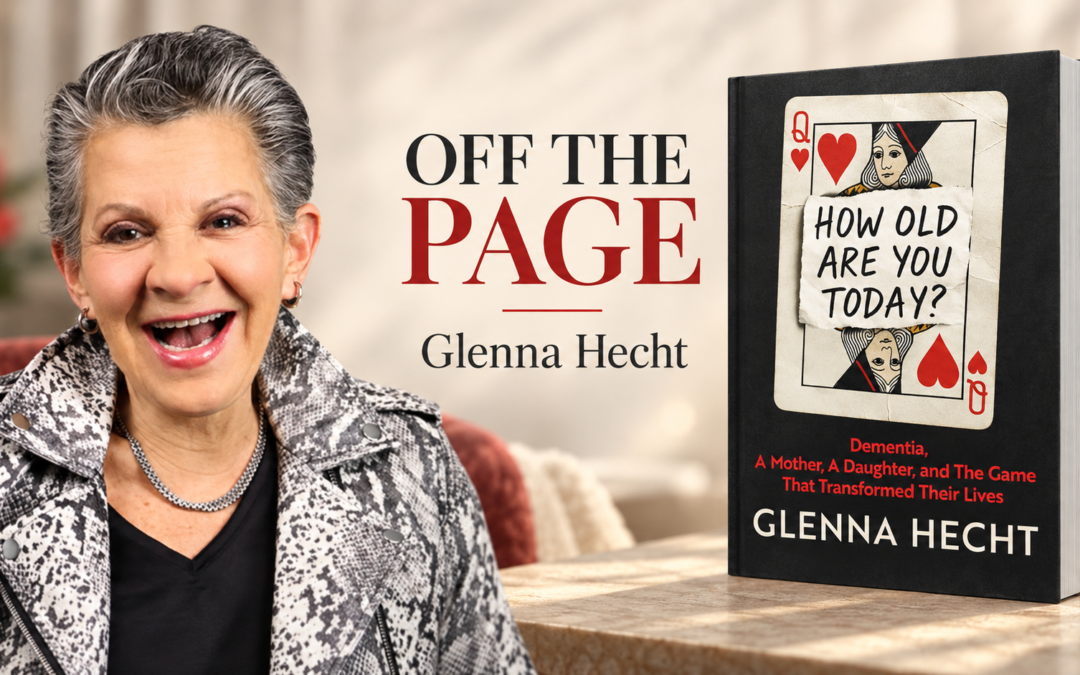
Glenna Hecht on the Question That Changed Her Relationship with Her Mother
Glenna Hecht spent much of her career solving difficult people problems. As a Human Resources leader, she was the person others turned to when the stakes were high and the answers were unclear.
Then her mother developed dementia. Glenna researched, organized, managed, and corrected—everything her professional life had taught her to do. But caregiving asked something different of her.
“It took me almost two years to understand: Dementia is not something you fix, it is something you face,” she says.
Glenna’s award-winning book, How Old Are You Today? Dementia, A Mother, A Daughter, and The Game That Transformed Their Lives, grew out of that realization and a question she began asking her mother.
A question becomes a doorway
One day, Glenna said to her mother, “I forgot. How old are you?”
“Guess,” her mother replied.
Glenna began offering numbers, asking “Higher or lower?” until they found an age that felt right to her mother that day. She might be 32, 45, or 54. Once Glenna knew the age, she could ask about that period of her mother’s life.
At first, Glenna didn’t understand what was happening. Later, she came to see that her mother was moving through different periods of her life. The question gave Glenna a way to join her there.
“That question became a ritual. The ritual became a game. Eventually, the game became a book,” Glenna says. “And now, the book has become a mission.”
The game also opened a new chapter in a relationship that had not always been easy. Glenna and her mother loved each other, but they had pushed each other’s buttons and had even been estranged at one point. When Glenna stopped trying to bring her mother into her own reality, they laughed together. She heard stories she had never heard before. They found a closeness that had once seemed out of reach.
Connection over correction
For Glenna, one of the hardest caregiving habits to let go of was correcting her mother.
“Imagine being told throughout the day that you’re wrong,” she says. “You’re wrong about what year it is. You’re wrong about where you live. You’re wrong about someone’s name. You’re wrong about your own age.”
She began to ask herself a different question: Does this need to be corrected? Often, the answer was no. She could ask a question instead and learn where her mother was.
That shift did not mean overlooking safety. It meant recognizing when a correction was needed and when it only served the caregiver’s need to be right.
One day, her mother did not recognize her. Glenna played their game and learned that, in her mother’s experience, she was 39.
“I hadn’t been born yet,” Glenna says. “Of course she didn’t know who I was. In the life she was living that day, I wasn’t there yet.”
Understanding that helped Glenna stop asking her mother to remember her and find another way to be with her.
When words were no longer enough
As her mother’s dementia progressed, she developed aphasia, affecting her ability to understand and express language. The conversations Glenna had known changed, but their communication continued.
They developed a system: one hand squeeze for yes, two for no.
“I thought words were central to communication,” Glenna says. “Dementia taught me that communication can exist without them.”
It is a lesson she carries into her work as a leadership strategist. For Glenna, listening means paying attention to the person in front of you and being willing to change your approach.
“If you care enough about connecting with another person, you keep looking for the door that is still open instead of standing in front of the one that closed.”
The story she needed eleven years to write
Glenna’s journey caring for her mother lasted nine years. It took her eleven years to write the book. She says the delay wasn’t about needing distance from the experience; she needed to become willing to tell the truth about it.
“I needed to be willing to be vulnerable. To admit that caregiving was hard. That I screwed up. That I didn’t know what I was doing,” she says.
She hopes that honesty helps other caregivers feel less alone. Dementia can bring grief, exhaustion, frustration, anger, guilt, and loneliness. Glenna does not ask families to set those feelings aside. She hopes they can also see the person they love and remain open to what is still possible between them.
“Your relationship may not look the way it did before,” she says. “That doesn’t mean there is nothing left to discover.”
Glenna has extended that hope beyond the book. She created the How Old Are You Today Fund to support dementia and Alzheimer’s research. According to Glenna, 30 percent of book proceeds support the fund. Her goals are to place 200,000 books into caregivers’ hands and contribute $2 million to research.
“My mother gave me an extraordinary final gift,” Glenna says. “She changed the way I understand connection, communication, and love. Now I get to decide what I do with that gift.”
About Glenna Hecht
Glenna Hecht is an award-winning author, speaker, and leadership strategist. How Old Are You Today? Dementia, A Mother, A Daughter, and The Game That Transformed Their Lives won the International Impact Book Award in Health: Dementia. Glenna previously led Human Resources for organizations including Starbucks, Walt Disney World’s Levy Restaurants, and Marshall Field’s.
Learn more about Glenna and her book on AMAZON. Connect with her on LinkedIn, Facebook, or Instagram.