How one enthusiastic reader can lead to more readers, speaking opportunities, introductions—and opportunities you never saw coming
Authors spend a lot of time thinking about how to find readers.
We build websites. We post on social media. We send emails. We arrange book signings. We pitch podcasts. We ask for reviews. We watch rankings. We try to understand algorithms that seem to change just about the time we think we've figured them out.
All of those things can have a place in a book marketing plan.
But one of the most valuable lessons I ever learned about promoting a book happened almost by accident.
It began with one reader, one conversation, and someone who happened to be listening.
One Reader. One Conversation. One Invitation.
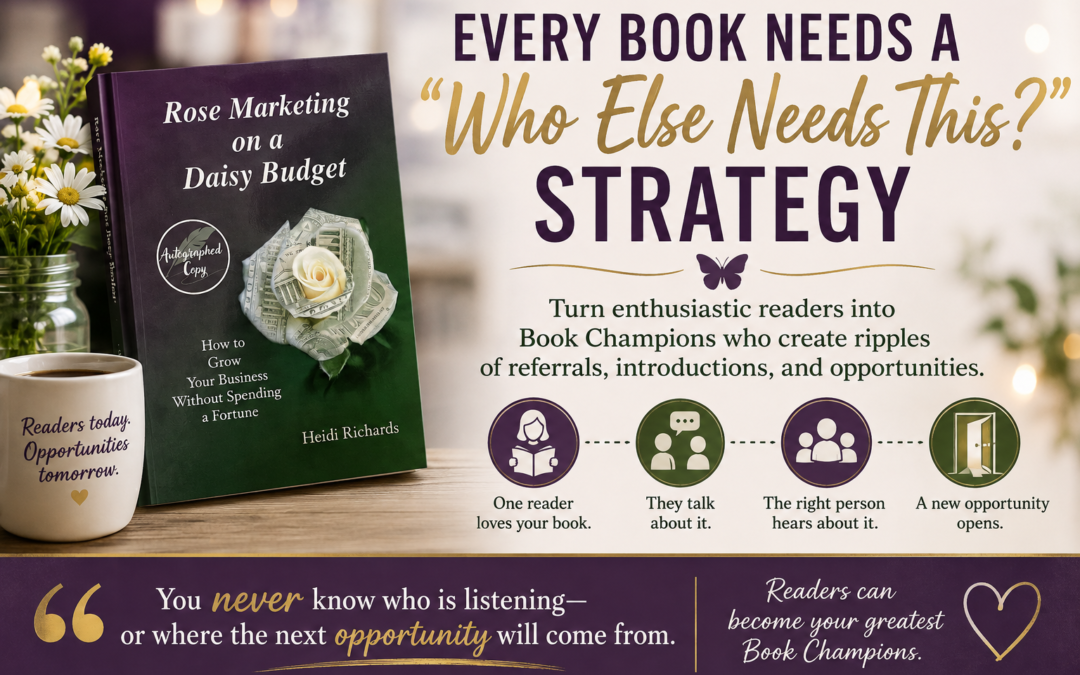
When my first book, Rose Marketing on a Daisy Budget, came out, a woman named Diane, who owned a professional organizing business, bought a copy.
Sometime later, she invited me to attend a local SBA meeting.
Diane had enjoyed my book, and at the meeting she began telling anyone who would listen about it. Her enthusiasm was contagious. Several people became interested and asked if they could buy a copy.
There was just one problem.
I hadn't brought any extra books to sell.
At the time, that felt like a missed opportunity.
It wasn't.
Something far more valuable was happening within listening distance.
Ed Healy, the director of the local SBA chapter, overheard Diane talking about my book. He came over, asked her about it, and then invited me to speak at his next event.
Of course, I said yes.
The day after my program, Ed sent me a message inviting me to become a regular speaker. And there was another bonus: I could sell my books after every program.
Think about the chain of events.
Diane bought a book.
She liked it.
She talked about it.
Someone overheard her.
That person invited me to speak.
One speaking engagement turned into an ongoing opportunity to speak—and sell books.
I couldn't have orchestrated that sequence if I'd tried.
And Diane wasn't following some carefully constructed marketing plan. She wasn't my publicist. I hadn't handed her talking points.
She was simply an enthusiastic reader who wanted other people to know about something she had enjoyed.
Looking back, Diane taught me an important lesson about book marketing that I didn't have a name for at the time:
Sometimes the most valuable thing a reader can do isn't buy another copy of your book. It's tell the right person about it.
The Question Authors Forget to Ask
When someone tells an author, “I loved your book,” we often have a predictable response.
First, we're delighted.
Then, somewhere in the back of our minds, comes the question:
“Would you leave a review?”
And we should ask. Reviews matter. They provide social proof, help future readers make decisions, and give authors valuable feedback.
But what if we added another question to our marketing mindset?
Who else needs this?
Not necessarily something you need to ask the reader directly.
It's a question for you to consider.
Who does this person know?
Where do they work?
What organizations do they belong to?
What communities are they part of?
Who comes to them for recommendations?
Where do they have influence?
Your reader may know someone who needs exactly what you've written.
And sometimes that connection can reach far beyond another individual book sale.
From Reader to Ripple
Imagine that you've written a leadership book.
A reader might recommend it to a colleague. That's wonderful.
But perhaps that reader also manages a department of 30 people.
Or belongs to a professional association with 500 members.
Or serves on a conference committee looking for speakers.
Or knows the editor of an industry newsletter.
Or hosts a podcast.
Or works for a company that regularly purchases books for leadership development.
Suddenly, one reader represents something much larger than one sale.
The same principle applies to virtually every type of book.
A memoir about caregiving might be recommended to a support organization.
A children's book might find its way to a teacher, librarian, school, parenting organization, or children's program.
A travel book might be discovered by a travel club, tourism organization, travel advisor, podcast, or special-interest group.
A historical novel might be recommended to a book club or historical society.
A book about entrepreneurship might reach a chamber of commerce, business association, incubator, college entrepreneurship program, or—as happened to me—the SBA.
One reader can create a ripple you never anticipated.
Readers Can Become Book Champions
There's a difference between someone who reads your book and someone who champions it.
A reader enjoys your book.
A Book Champion talks about it.
They recommend it. Share it. Give it as a gift. Mention it in conversations. Introduce you to someone. Invite you to speak. Suggest your book to a group. Post about it online. Tell a friend:
“You need to read this.”
And there's something particularly powerful about that recommendation.
It's not coming from the author.
It's coming from someone who has nothing to gain by making it.
That's why word of mouth has always been one of the most powerful forms of marketing.
A reader buys your book. A Book Champion helps your book travel.
Don't Turn Your Readers Into Salespeople
There's an important caveat to all of this.
A “Who Else Needs This?” strategy should never mean treating every person who compliments your book like an unpaid member of your sales force.
Imagine telling an author:
“I absolutely loved your book.”
And immediately hearing:
“Great! Who can you introduce me to?”
That's not relationship marketing. That's prospecting with better manners.
Instead, allow recommendations to happen naturally—and make it easy for readers who want to help you.
You might simply say:
“Thank you. That means so much to me. If you ever think of someone else who might benefit from the book, I'd be grateful if you passed the title along.”
If someone mentions an organization or group, you might say:
“I'd love to speak with a group like that. Please keep me in mind if the opportunity ever comes up.”
You're not assigning homework.
You're planting a seed.
And sometimes seeds grow in places you never expected.
Give Your Book Champions Something to Work With
There's another part of this strategy authors often overlook.
People may want to recommend you but not know exactly how.
Make it easy.
Have a short, compelling description of your book that someone else could easily repeat. Be able to explain in one or two sentences who the book is for and why it matters.
And have simple materials available when appropriate: an author or book one-sheet, your website, a direct book link, speaking topics, a brief bio, shareable graphics, discussion questions, review excerpts, bulk-order information, or a media kit.
Ask yourself:
If someone wanted to recommend my book or introduce me today, would I make it easy for them?
Enthusiasm gets the conversation started.
Preparation helps turn that conversation into an opportunity.
The “Who Else Needs This?” Exercise
Take ten minutes and think about your own book.
Start with the most obvious question:
Who needs this book?
Now go one step further.
Think about the people who have already read it and responded positively. Instead of viewing them simply as past customers, consider the worlds they are connected to.
Ask yourself:
- Who else might benefit from what I've written?
- What organizations serve those people?
- What associations do they belong to?
- What conferences or events do they attend?
- What podcasts do they listen to?
- What newsletters or publications do they read?
- What book clubs or online communities might discuss this topic?
- Could my book be useful to a company, nonprofit, school, library, professional organization, or community group?
- Could someone use my book as a gift for employees, clients, students, members, friends, or family?
- Who already knows, serves, teaches, leads, entertains, or communicates with the people I want to reach?
Now your marketing possibilities begin to look very different.
Instead of asking only:
“How can I sell another book?”
You're asking:
“How can this book travel farther?”
That's a much bigger question.
Consider the Fiction Reader
This strategy isn't limited to nonfiction.
Imagine someone reads a historical novel and loves it.
She recommends it to her book club. The club chooses it as its monthly selection and invites the author to join their discussion virtually.
One of the members volunteers at a local library and recommends the author for an upcoming program.
Someone attending the library event belongs to a historical society and mentions the book there.
The author didn't reach all of those people individually.
One reader created the first ripple.
That's the beauty of word-of-mouth marketing. You don't always know where the ripple will go.
Stop Measuring Every Reader as One Sale
Authors understandably pay attention to numbers.
How many copies sold?
How many reviews?
How many followers?
How many people opened the email?
How many clicked?
Those numbers can tell us useful things.
But they don't tell us everything.
One reader may purchase one book and never mention it again.
Another reader may purchase one book and introduce you to an organization that buys 100 copies.
Another might recommend you to a podcast that introduces you to thousands of listeners.
Another might invite you to speak.
Another might give your book to someone who becomes a client, collaborator, friend, advocate, or future opportunity.
That's why we shouldn't measure every reader solely by the value of one transaction.
Don't measure every reader by one sale. Consider the ripple that reader might create.
And Then Ask: Where Are They Already Gathering?
Once you begin asking “Who else needs this?”, another powerful marketing question naturally follows:
Where are those people already gathering?
Rather than trying to build every audience from scratch, look for the communities that already have the attention of your readers.
Associations.
Conferences.
Book clubs.
Podcasts.
Newsletters.
Professional organizations.
Libraries.
Schools.
Networking groups.
Online communities.
Special-interest organizations.
Instead of constantly asking people to come into your world, find thoughtful ways to participate in theirs.
Don't arrive simply to sell your book.
Teach something.
Contribute something.
Start a conversation.
Offer a resource.
Share your expertise.
Build a relationship.
Bring value before asking for attention.
That's how one introduction can become a relationship rather than simply another marketing transaction.
Your Next Opportunity May Already Be One Conversation Away
I couldn't have known that Ed Healy would be standing nearby when Diane began talking about Rose Marketing on a Daisy Budget.
I certainly couldn't have predicted that her enthusiasm would lead to a speaking invitation, or that one presentation would lead to an opportunity to become a regular speaker and sell my books after each program.
That's precisely why I've never forgotten the experience.
Authors spend enormous amounts of time trying to reach people who have never heard of us.
And yes, reaching new readers is part of the business of being an author.
But perhaps we should also spend more time appreciating, nurturing, and equipping the people who already believe in what we've written.
The next time someone tells you:
“I loved your book.”
Thank them.
Celebrate the moment.
Ask for the review when appropriate.
But don't forget the bigger possibility.
Ask yourself:
Who else needs this?
Your next reader may be one recommendation away.
Your next speaking engagement may be one introduction away.
Your next bulk order may be one conversation away.
And your next opportunity may be standing within listening distance when someone who loves your book starts talking about it.
You never know who is listening—or where the next opportunity will come from.
So give your readers something worth talking about—and give your Book Champions every reason to keep the conversation going.