The Hidden Cost of Rapid Publishing in the Age of AI
By Heidi Richards Mooney
What if you could publish a new book every week?
For many authors, that once sounded impossible. Today, with artificial intelligence assisting with research, outlining, drafting, editing, and production, publishing at that pace is becoming increasingly achievable.
But just because we can publish faster, does that mean we should?
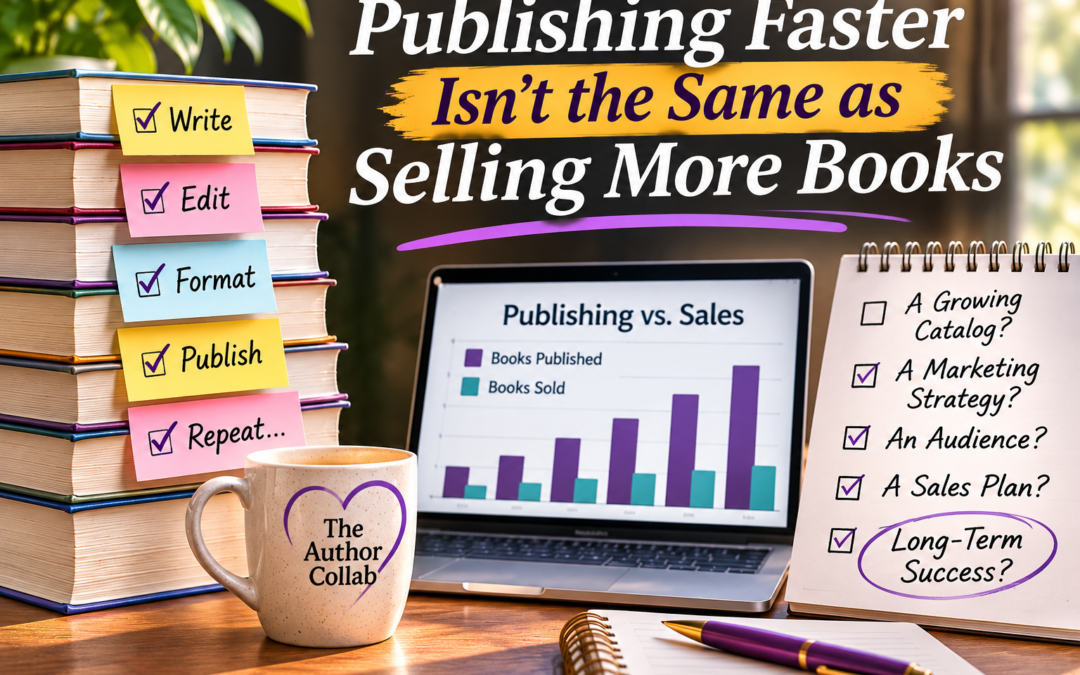
A recent discussion among authors raised a fascinating business dilemma: How do you balance the ability to publish more books with the time, money, and attention required to make those books successful?
It's a question worth exploring because publishing has changed dramatically, but one fundamental truth remains:
Publishing a book and building a successful publishing business are two very different accomplishments.
The New Publishing Bottleneck
For generations, the greatest challenge facing authors was getting a book written and published.
Today, technology has significantly reduced some of those barriers.
AI tools can accelerate research, help organize information, generate ideas, and assist with countless production tasks. Independent publishing platforms have made distribution more accessible than ever.
Yet something interesting happens when the production process speeds up.
The bottleneck moves.
Instead of asking, "How quickly can I finish my next book?" authors increasingly find themselves asking:
- How will readers discover this book?
- How much should I spend testing its potential?
- How long should I wait before evaluating its performance?
- How do I know whether to invest more or move on?
- Am I creating new books faster than I can effectively market the ones I've already published?
These aren't simply publishing questions. They're business questions.
And they deserve thoughtful answers.
The $3-a-Day Reality Check
One author participating in the discussion shared that she typically begins testing new books with an advertising budget of just $3 per day.
That sounds manageable.
But consider what happens when an author releases a new book every week.
| Books advertised | Daily budget | 30-day cost |
|---|---|---|
| 1 | $3 | $90 |
| 5 | $3 each | $450 |
| 10 | $3 each | $900 |
| 20 | $3 each | $1,800 |
Suddenly, even a modest advertising strategy can become a significant monthly expense.
And that's before accounting for cover design, editing, formatting, software subscriptions, promotional services, and the author's time.
Personally, I often begin with an even smaller advertising budget of approximately $2 per day.
But regardless of the amount, the principle remains the same.
A small budget multiplied across a growing catalog can become a large financial commitment.
The solution isn't necessarily to stop advertising. It's to become more intentional about which books receive additional investment.
Not Every Book Needs the Same Marketing Budget
One of the most useful ideas raised in the discussion was the importance of evaluating a book's fundamentals before investing heavily in advertising.
Consider three questions:
1. Is there a clearly defined audience?
A book written for everyone often struggles to connect with anyone. Authors need to understand who their ideal readers are and why those readers would choose their book.
2. Does the book communicate its value immediately?
A compelling cover, title, subtitle, description, and relevant keywords can make the difference between a reader clicking and scrolling past.
3. Is there evidence of genuine reader interest?
This might come from early reader feedback, newsletter responses, advance reader interest, relevant communities, or initial sales.
A book with strong fundamentals may be a better candidate for paid advertising than one whose positioning still needs work.
However, there's an important distinction: a book receiving little organic attention isn't necessarily a book without potential.
Sometimes the problem isn't the book.
It's that the right readers haven't discovered it yet.
How Long Should You Test a Book?
Authors often want a simple answer to this question.
Should you advertise for seven days? Two weeks? A month?
Unfortunately, there isn't a universal testing period that works for every book, genre, or advertising campaign.
For a small initial Amazon Ads test, some authors use daily budgets of approximately $2 to $8 and evaluate results over two to four weeks.
But the calendar alone doesn't determine whether a test has been meaningful.
A campaign that receives only a handful of clicks in 30 days may provide less useful information than one that generates substantial relevant traffic in a shorter period.
Instead of focusing exclusively on time, examine the results.
Look at impressions. Are readers seeing your advertisement?
Look at clicks. Is your cover, title, and positioning generating interest?
Look at conversions. Are those clicks translating into purchases?
Look at profitability. Are you spending more to acquire a customer than you're earning from the sale?
For example, if you earn $4 in royalties from a sale and spend $6 in advertising to generate that sale, you're losing $2 on the immediate transaction.
That might be acceptable under a deliberate strategy to acquire series readers or generate future sales, but it shouldn't happen accidentally.
Understanding your break-even point is essential.
And remember that advertising data can be incomplete or delayed. A few disappointing days don't necessarily mean a book has failed.
The Learning Problem Nobody Talks About Enough
There's another challenge with rapid publishing that deserves just as much attention as advertising costs.
When do authors have time to learn from their results?
Imagine publishing four books in four weeks.
By the time the first book has accumulated enough meaningful feedback to reveal what readers respond to, you've already released three more.
What if the first book's title was confusing?
What if readers preferred a different angle on the subject?
What if the cover attracted clicks but the description failed to convert them into sales?
Those insights could have improved your next release.
But you've already moved on.
This is one of the hidden costs of publishing too quickly.
You're not simply risking money.
You're risking the opportunity to become a better publisher.
Sometimes slowing down long enough to evaluate what worked, what didn't, and why can save enormous amounts of time and money in the future.
The Six-Figure Author Who Discovered That More Isn't Always Better
One particularly revealing contribution came from an author who shared that her fiction business had previously generated six figures in annual revenue.
Since then, her revenue has declined significantly, and the demanding nature of fiction writing has contributed to burnout.
She's now exploring nonfiction partly because AI tools allow her to create and test books more quickly.
Her experience illustrates something important.
Even authors who have achieved substantial financial success can face new challenges as markets, technology, and reader behavior evolve.
And perhaps her most important observation was that publishing more books means little if you haven't mastered how to market them.
That's a lesson authors at every experience level can appreciate.
Success isn't necessarily about producing more inventory.
It's about creating books readers want and developing reliable ways to connect those books with their audiences.
The Overlooked Opportunity: Getting More From the Books You Already Have
This is where I believe many authors are leaving tremendous opportunities unexplored.
We're so focused on the next book that we sometimes overlook the possibilities within the books we've already written.
Consider a nonfiction book.
One well-developed book can become the foundation for:
- Articles and guest blog posts
- Podcast interviews
- Workshops and webinars
- Speaking presentations
- Online courses
- Downloadable worksheets and workbooks
- Email newsletter content
- Social media discussions
- Book club or community conversations
- Collaborative promotional campaigns
Each creates another opportunity to introduce readers to your ideas and, ultimately, your book.
And unlike producing an entirely new title, these activities can build on work you've already completed.
This doesn't mean endlessly recycling the same material.
It means recognizing that a book is more than a product sitting on a digital shelf.
A book can become the foundation of an entire ecosystem of content, conversations, relationships, and revenue opportunities.
For nonfiction authors in particular, this can be a powerful way to increase a book's reach without constantly increasing publishing output.
Why Collaboration Belongs in Your Testing Strategy
Advertising isn't the only way to discover whether a book resonates with readers.
Collaboration can provide valuable information while expanding visibility.
Consider what happens when authors work together to introduce their books to new audiences.
They might participate in newsletter swaps, collaborative interviews, joint promotions, reader communities, themed book showcases, or coordinated book events.
These activities can help authors learn which messages attract interest, which audiences respond, and which promotional approaches deserve further attention.
Of course, collaboration isn't automatically free. It requires time, planning, relationships, and sometimes financial investment.
And it doesn't guarantee sales.
But it can create something advertising alone often cannot: meaningful connections with other authors, readers, and potential partners.
That's one of the reasons I believe so strongly in creating opportunities for authors to support one another.
Collaboration isn't simply about promoting a book. It's about expanding the opportunities surrounding it.
A Smarter Approach: Publish, Test, Learn, Expand
Rather than choosing between publishing rapidly and slowing down completely, authors might benefit from a more flexible approach.
Step 1: Validate before you publish
Research your audience, study comparable books, examine reader needs, and test your positioning whenever possible.
Don't confuse the ability to produce a book quickly with evidence that readers want it.
Step 2: Establish a realistic testing budget
Decide what you can afford to invest without putting unnecessary pressure on your business.
A small, controlled test can be useful, but only when you understand what you're trying to learn.
Step 3: Combine paid and organic promotion
Use your email list, reader communities, content marketing, partnerships, and other appropriate channels alongside paid advertising.
This creates more opportunities to gather feedback and reach potential readers.
Step 4: Measure meaningful results
Don't judge success solely by impressions, clicks, or a temporary ranking improvement.
Consider sales, royalties, reader response, profitability, and whether the book is helping you achieve your larger goals.
Step 5: Improve before increasing investment
If readers are clicking but not buying, examine your book's description, reviews, pricing, and positioning.
If nobody is clicking, reconsider the cover, title, targeting, or advertising message.
A disappointing result is useful only when you learn from it.
Step 6: Expand what works
When a book demonstrates genuine potential, explore ways to build on that success.
Increase advertising carefully, create complementary resources, pursue speaking opportunities, or develop related titles.
Let what you learn influence what you create next.
The Question AI Can't Answer for Us
Artificial intelligence is changing the economics and speed of publishing.
It can help authors work faster, experiment with ideas, and manage tasks that once required considerably more time.
But speed doesn't eliminate the need for judgment.
It doesn't replace understanding your readers.
It doesn't guarantee that a book will stand out in a crowded marketplace.
And it certainly doesn't guarantee that a faster publishing schedule will produce a more profitable business.
In fact, as more content becomes easier to produce, I believe quality, originality, differentiation, and reader trust will become even more valuable.
The authors who succeed won't necessarily be those who publish the greatest number of books.
They may be the ones who make the smartest decisions about the books they publish.
Final Thoughts: Are You Publishing Books or Building Opportunities?
I've spent decades in business, publishing, marketing, and helping entrepreneurs find new ways to grow.
One lesson continues to prove itself:
Sometimes the greatest opportunity isn't in creating something new.
It's in getting more value from something we've already created.
There is absolutely a place for rapid publishing. For some authors, particularly those working in well-researched niches or established series, a faster release schedule may be an effective business strategy.
But publishing speed should serve a purpose.
It shouldn't become the purpose.
Before rushing to release another book, consider whether you've given your existing titles enough attention, enough testing, and enough opportunities to find their readers.
Because the question may not be:
"How many books can I publish?"
It may be:
"How much opportunity am I giving each book to succeed?"
And that might be the most important publishing question of all.
Let's Continue the Conversation
How do you balance publishing new books with marketing the ones you've already written?
Do you set aside a testing budget for each release? Do you wait for meaningful results before publishing your next book? Or have you discovered a completely different approach?
We'd love to hear what's working for you.
Share your experiences and insights with The Author Collab community.
Heidi Richards Mooney is an author, publisher, entrepreneur, and founder of The Author Collab, a platform dedicated to helping authors expand their visibility, build meaningful collaborations, and create more opportunities for their books.