Every author dreams of the day an editor reaches out and says, "I'd love to see more of your work." Recently, I received exactly that email. It came from a "Senior Editor" at a respected publishing house, it mentioned my book by name, and it praised the very things I'm most proud of.
It was also almost certainly a scam.
Scammers know that authors pour years into their books and long for recognition. That makes us ideal targets. And with AI now writing their emails, these messages are more polished and personal than ever. Here's what I received, the warning signs I spotted, and how you can protect yourself.
The Email
I've changed the name, publisher, and book title, but otherwise this is the message nearly as it arrived:
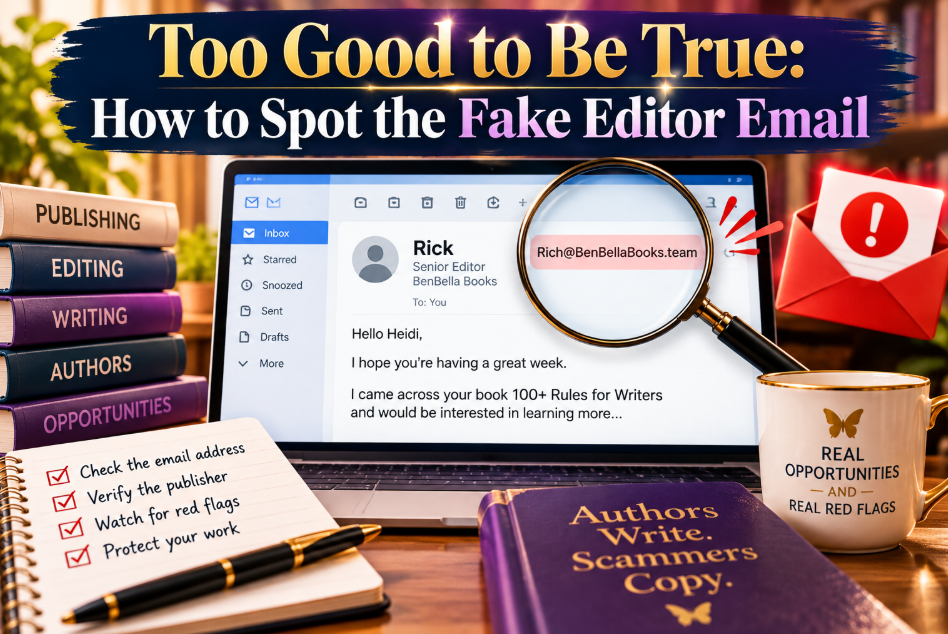
Hello Heidi,
I hope you're having a great week.
My name is Richard, and I serve as a Senior Editor at [Respected Publishing House]. My work involves evaluating nonfiction for potential publication, with a particular interest in insightful ideas, practical value, distinctive perspectives, and projects that have the potential to connect with readers.
I came across [Your Book Title] while reviewing writing and publishing nonfiction. Based on the premise and publicly available information, I was interested in learning more about the project. I have not read the complete book at this stage, but the material available gave me a reason to reach out.
Your approach of bringing together lessons from influential writers while encouraging readers to question conventional advice and develop their own writing practices stood out to me...
I would also be interested to know whether you are currently represented by a literary agent...
If you are open to discussing the project further, I would appreciate it if you could send me the manuscript for consideration...
I would also be interested to know whether you are developing another manuscript...
Flattering, professional, and specific. It's easy to see why so many authors reply.
The Red Flags Hiding in Plain Sight
Once I looked closer, the warning signs added up quickly.
- It follows a known script. The Alliance of Independent Authors describes this exact pattern: a supposed editor at a well-known house praises your work, asks what you've written and what's in the pipeline, and asks whether you have an agent. My email checked every box.
- The praise is secondhand. He admits he hasn't read the book. The compliments simply restate the book's public description, a hallmark of AI-generated summaries pulled from an author's website or listings.
- It asks for a manuscript of a book that's already published. Acquiring editors don't typically cold-pitch authors of existing books this way.
- It came out of nowhere. I never submitted anything to this publisher. Writer Beware's rule of thumb: any publishing email you can't tie to a submission or contact you made yourself is very likely a scam.
- There's no way to verify him. A first name only, no direct phone number, and no link to a staff page.
- Even the greeting is familiar. Penguin Random House published a sample scam email that opens almost exactly the same way.
What Usually Happens Next
The first email rarely asks for money. That comes later. Once you reply and send your manuscript, you'll often hear that the book has real promise but first needs professional editing, a new proposal, a marketing package, or a "review" from a recommended partner, all for a fee.
Some of these emails aren't after money at all. Cybersecurity specialists warn they may be a way to deliver malicious software through links or attachments.
Remember this simple truth: legitimate publishers do not charge authors to review a manuscript or consider a book for publication. If money enters the conversation, walk away.
How to Verify Before You Reply
If an offer like this lands in your inbox, slow down. Scammers count on your excitement.
- Check the sender's address. A real editor writes from the publisher's own domain. Gmail, Outlook, or a domain that's slightly misspelled is a giveaway.
- Look them up. Search the publisher's website and LinkedIn for the editor's name and title.
- Contact the publisher directly. Use the phone number or email on the publisher's official website, not the one in the message, and ask whether the person works there and sent the email.
- Don't send files or click links until you've confirmed the sender is real.
- Ask a fellow author. A second set of eyes from someone you trust can spot what excitement hides.
- Report it. Writer Beware and the Authors Guild track these scams, and the FTC accepts reports at reportfraud.ftc.gov.
Protect Your Work, Lean on Your Community
Your book deserves recognition, and real opportunities do come. But they rarely arrive as a cold email from a stranger who hasn't read your work. They grow from relationships you build, submissions you make, and communities that genuinely support one another.
That's one of the reasons The Author Collab exists. When we share what we're seeing, including the scams, we protect each other. If you receive an email that feels too good to be true, share it with the community before you reply. Chances are, someone has seen it before.
Have you received an email like this? Tell us in the comments so we can all stay one step ahead.
Sources
- Penguin Random House: How to Spot and Avoid Phishing Scams Targeting Authors
- Alliance of Independent Authors: Scam Emails Impersonating Editors on the Rise
- Writer Beware
- Authors Guild: Rise in Email Scams Targeting Authors
- W. W. Norton: Fraudulent Emails and Impersonation Scams
- Books+Publishing: Publishers Warn of Fraudulent Emails