How to turn the information, discoveries, and insights behind your book into articles, social media posts, newsletters, and conversations that attract readers.
Your Research Has More Stories to Tell
Think back to the time you spent researching your book.
Maybe you interviewed experts, studied historical events, explored unfamiliar places, uncovered surprising statistics, or spent hours reading about a subject that fascinated you.
Perhaps you discovered something so interesting that you couldn't wait to tell someone about it.
Some of those discoveries became part of your manuscript. Others were set aside because they didn't fit the story, interrupted the flow, or took your writing in a direction you hadn't intended.
But here's something worth considering:
Just because a discovery didn't make it into your book doesn't mean it has no value.
In fact, some of your most interesting marketing content may be hiding in the research you collected along the way.
Authors often feel pressured to continually create something new to promote their books. Another social media post. Another newsletter. Another article. Another reason to remind people that their book exists.
Yet much of the material they need may already be sitting in their research folders, notebooks, bookmarks, interview transcripts, and earlier drafts.
You don't always have to begin with a blank page.
Sometimes you simply need to revisit the pages you've already filled.
And here's the opportunity: Your research can do more than support your book. It can help you introduce that book to people who haven't discovered it yet.
Your Book Is Only Part of the Story
When readers purchase a book, they see the finished work. They rarely see everything that happened behind the scenes.
They don't know about the fascinating fact that sent you down a three-hour research rabbit hole.
They haven't heard the interview that changed your perspective.
They don't know which historical detail inspired a character, which statistic surprised you, or which discovery caused you to rewrite an entire chapter.
Those are stories worth telling.
And sharing them gives readers another way to connect with your work.
For nonfiction authors, research can demonstrate expertise, explain complex ideas, challenge assumptions, and offer practical solutions.
For fiction authors, research can bring a setting, historical period, profession, culture, or character's experience to life.
In both cases, you're offering something valuable before asking someone to buy your book.
You're giving readers a reason to become interested.
Look for the Stories Behind Your Research
Start by revisiting the material you gathered while writing your book.
Look for:
- Surprising facts: Information that challenges what people commonly believe.
- Interesting statistics: Numbers that tell a compelling story or reveal an unexpected trend.
- Historical discoveries: Details about people, places, customs, or events that helped shape your writing.
- Expert insights: Lessons or perspectives from interviews and conversations.
- Behind-the-scenes moments: Research that influenced a character, chapter, argument, or storyline.
- Unanswered questions: Topics you explored but couldn't fully address in the finished book.
- Personal discoveries: Things you learned that changed how you think about your subject.
You may be surprised by how many potential articles, posts, and conversations emerge from this simple exercise.
And don't overlook the research you decided not to use.
Sometimes the information that didn't belong in your book is exactly what would make an engaging standalone article.
A Simple Formula: Fact + Why It Matters + Connection
One of the easiest ways to turn research into content is to use this three-part formula:
FACT + WHY IT MATTERS + CONNECTION TO YOUR BOOK
Here's how it works.
1. Share the fact or discovery.
Begin with something interesting enough to capture attention.
2. Explain why it matters.
Give readers a reason to care. What does this information reveal, challenge, explain, or help them understand?
3. Connect it to your book.
Show how the discovery influenced your writing, relates to your subject, or offers a glimpse into the world you've created.
The connection doesn't have to be a sales pitch. In fact, it's often more effective when it isn't.
Example for a Historical Fiction Author
Suppose you discovered an unusual wedding tradition while researching the period in which your novel takes place.
You could share the tradition, explain what it reveals about the society of that time, and describe how it influenced a scene or relationship in your story.
Suddenly, you're not simply announcing that you've written a historical novel.
You're inviting readers into the world of your book.
Example for a Nonfiction Author
Imagine you're writing about leadership and uncover research suggesting that employees often value recognition and meaningful feedback as much as, or more than, certain traditional workplace rewards.
You could share the finding, explain what it means for today's leaders, and connect it to a principle you explore in your book.
Now you're providing useful information while demonstrating the relevance of your work.
When sharing statistics or research findings, identify the original source and make sure the information is accurate and current.
Turn One Discovery into Several Pieces of Content
Here's where this strategy becomes especially useful.
You don't have to create an entirely new idea for every platform.
One discovery can become several different pieces of content, each presented in a way that fits its audience.
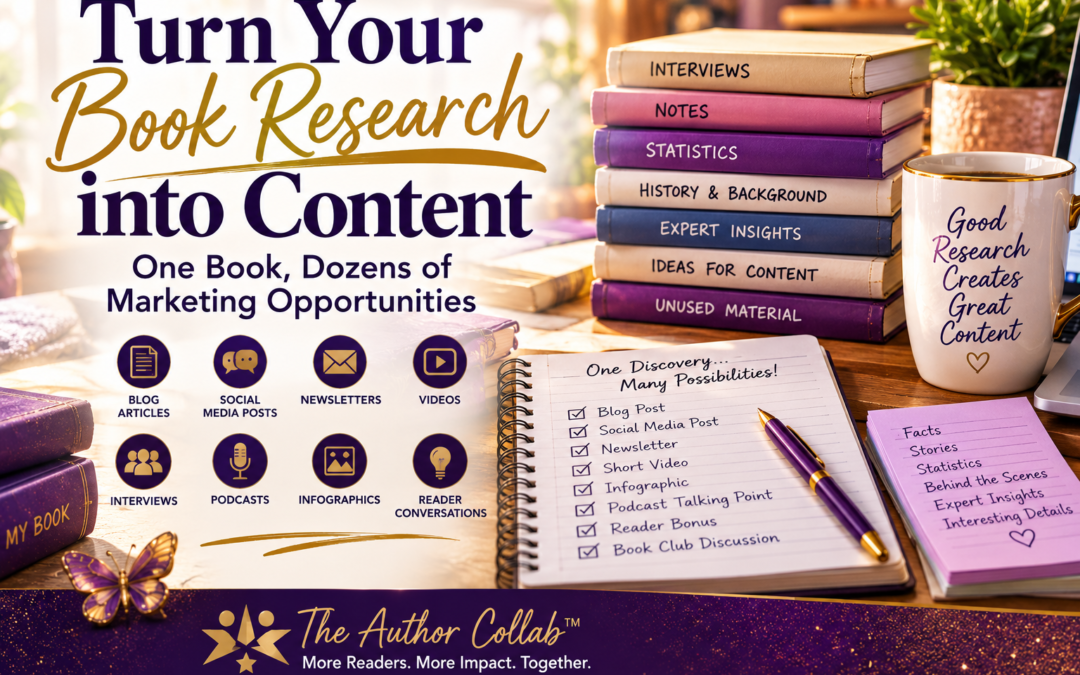
For example, you could turn a single research finding into:
A social media post: Share the discovery and ask readers what they think.
A blog article: Explore the subject in greater depth and connect it to your book.
A newsletter feature: Tell the story of how you discovered the information and why it interested you.
A short video: Explain the finding in a minute or two.
An infographic: Turn statistics, comparisons, or a historical timeline into something visual.
A podcast talking point: Use the discovery as a starting point for an interview or discussion.
A reader bonus: Create a short behind-the-scenes feature with information that didn't make it into the finished book.
A book club discussion question: Invite readers to explore how the discovery relates to the themes or ideas in your work.
That's eight possible uses from one piece of research.
And you may discover even more.
The goal isn't to repeat the exact same content everywhere. It's to adapt one good idea for different formats, audiences, and conversations.
Don't Forget the Research That Changed Your Mind
Some of the most compelling stories authors can share begin with a simple admission:
“I thought I knew this subject until I started researching it.”
Perhaps you discovered that a widely accepted belief wasn't entirely accurate.
Maybe an expert challenged your assumptions.
Perhaps a historical account contradicted something you'd always been taught.
Or maybe you uncovered information that changed the direction of your book.
Those moments make wonderful content because they invite curiosity.
Readers enjoy discovering something new, especially when the author is willing to share what they learned along the way.
You don't have to present yourself as someone who knew everything before beginning the project.
Sometimes the most interesting story is how your understanding evolved.
Build a Research-to-Content Folder
Rather than trying to remember every useful discovery, create a simple system for saving them.
You could use a spreadsheet, document, notebook, or folder organized around your book's themes.
For each promising idea, record:
- The research finding or discovery
- Where you found it, including the source or citation
- Why readers might find it interesting
- How it connects to your book
- Possible content formats
- Whether you've already shared it
You might even create a folder titled “Content Hiding in My Research.”
As you write future books, add to it.
Over time, you'll develop a collection of ideas you can draw from whenever you need inspiration for an article, newsletter, interview, or social media post.
And when someone asks, “What should I post about my book this week?” you may already have the answer.
Remember: Give Readers Something Worth Sharing
There's an important distinction between using research to create valuable content and simply turning every discovery into another advertisement.
Readers don't necessarily want to hear “Buy my book” every time they encounter your name.
But they may appreciate learning something fascinating.
They may enjoy a behind-the-scenes story.
They may want to share an unusual fact with a friend.
And when your content consistently informs, entertains, inspires, or starts meaningful conversations, readers begin to associate those experiences with you and your work.
That's how a simple piece of research can contribute to long-term author visibility.
You're not just promoting a title.
You're giving people reasons to remember the person who wrote it.
Your Research Doesn't Have to End When Your Book Is Published
Writing a book requires an enormous investment of time, curiosity, creativity, and attention.
You gather information. You ask questions. You explore ideas. You follow unexpected paths. You make discoveries that sometimes change the very direction of your work.
Why should all that effort serve only one purpose?
Your finished book may be the most visible result of your research, but it doesn't have to be the only one.
The information you collected can continue working for you long after publication.
It can introduce new readers to your subject.
It can help establish your expertise.
It can provide meaningful content for your website, newsletter, and social media channels.
It can create opportunities for interviews, speaking engagements, and conversations.
And perhaps most importantly, it can remind you that the work you've already done has continuing value.
Here's Your Author Challenge
Go back through your book research and identify five discoveries that someone outside your immediate readership might find interesting.
Choose one.
Then use the formula:
FACT + WHY IT MATTERS + CONNECTION TO YOUR BOOK
Turn it into a short post, an article, or a conversation starter.
You may find that your next great marketing idea has been waiting in your research notes all along.
Remember: You researched it once. You can share what you learned in dozens of ways.
And sometimes, the story behind the book is just as interesting as the story inside it.
Keep Your Book Visible with The Author Collab™
At The Author Collab™, we believe that publishing a book is only the beginning of its journey.
Explore our articles, practical author resources, marketing ideas, and collaboration opportunities designed to help you connect with more readers and create lasting visibility for your work.
Visit TheAuthorCollab.com to explore our growing Author Resources Library and discover more ways to make your words work for you.
The Author Collab™ — More Readers. More Impact. Together.