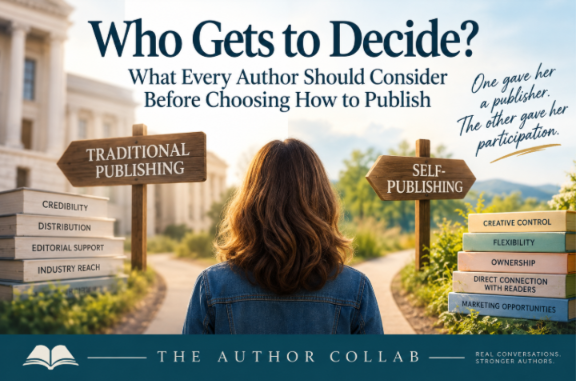
The debate over traditional publishing vs. self-publishing often focuses on which option is better. But I think there's a more useful question for authors to ask: How much of your book are you willing to hand over to someone else?
An author friend recently asked me about my experience with traditional publishing versus self-publishing.
Her question came with a story.
Evelyn had been given an assignment to write a book that was ultimately published in 2016. It was a fascinating project that used stories to explore unusual genetic and mental health disorders, environmental illnesses, infectious diseases, and conditions with no clearly explained origin.
She wrote the book.
But once the manuscript left her hands, many of the decisions surrounding it were no longer hers.
She wasn’t involved in choosing the cover—and she still doesn’t like it. She wasn’t involved in marketing the book. The publishing company was eventually sold, and today the book remains available on Amazon at a price of approximately $75.
Her experience with self-publishing has been very different.
Evelyn and her Co Author Natalie (daughter) have also self-published two travel books, Have a Love Affair with Travel and Have a Love Affair with the USA. With those books, they were involved throughout the process. Even better, they discovered that they enjoy marketing them.
Her story prompted a larger conversation between us.
And it raises a question I think every author should ask before deciding how to publish:
How much of your book are you willing to hand over to someone else?
Traditional Publishing Offers Something Valuable
There are very good reasons authors pursue traditional publishing.
A respected publisher can bring credibility, professional editing, industry knowledge, distribution relationships, production expertise, and access to opportunities an author may have difficulty securing independently.
For an unknown author in particular, having an established publishing house choose your manuscript can provide a powerful stamp of approval.
But there is a tradeoff.
When a publisher invests its money, expertise, reputation, and resources into your book, it also has a financial interest in how that book is positioned and sold.
That can mean decisions about your title, cover, pricing, positioning, marketing, and sometimes even the manuscript itself may not belong entirely to you.
I once worked with an author whose publisher loved her book and wanted to publish it—with one rather significant condition.
They wanted her to change the focus of the book.
And the ending.
She tried.
She genuinely attempted to reshape the manuscript to meet their expectations, but eventually realized that the book they wanted to publish was no longer the book she wanted to write.
Ultimately, she took it back and self-published it.
Self-Publishing Changes Who Is Sitting in the Decision-Making Chair
Self-publishing once carried a stigma. Today, it has become a mainstream publishing path.
But self-publishing isn't simply traditional publishing without the publisher.
When you self-publish, you become the publisher.
That means you get to choose the title.
You approve the cover.
You determine the price.
You decide when the book is published, where it is distributed, how it is marketed, when it goes on sale, whether the content gets updated, and how the book fits into the rest of your business, speaking, consulting, or author platform.
That freedom can be exhilarating.
It can also be a tremendous amount of work.
Creative control comes with responsibility.
If you want professional editing, you have to find it. If you want a great cover, you have to make sure it gets designed. Distribution, formatting, metadata, pricing, publicity, reviews, marketing—the decisions eventually land on your desk.
For some authors, that sounds exhausting.
For others, it sounds wonderful.
I fall into the second group.
I Chose Self-Publishing Before It Was Fashionable
I have never published a book through a traditional publishing house.
When I wrote my first book, I wasn't dreaming about seeing my name on a bookstore shelf. I had a very specific goal.
I wanted my book to be a marketing tool.
Around that time, I met Dan Poynter, one of the pioneers of independent publishing. He helped make self-publishing feel not only possible but practical.
For what I wanted my book to accomplish, it made sense.
There was another reason, too.
I'm not particularly good with rejection.
If someone tells me no, my natural inclination is to find another way.
For some writers, querying agents and publishers is part of the journey. They can collect rejection letters, learn from them, refine their pitches, and keep going until the right person finally says yes.
That persistence is admirable.
But rejection can also be demoralizing, particularly when an author has spent years creating something deeply personal.
Self-publishing removes one particular gatekeeper from the equation.
You don't need someone else's permission to become an author.
But you do assume responsibility for becoming a publisher.
And that's an important distinction.
Maybe We're Asking the Wrong Question
Authors frequently ask:
Should I traditionally publish or self-publish?
Perhaps that's not the first question we should be asking.
Instead, ask:
How important is creative control to me?
How involved do I want to be in decisions about my cover, title, pricing, and positioning?
Do I want someone else investing financially in my book, or am I prepared to invest in it myself?
How much responsibility do I want for marketing?
How important is traditional distribution to my goals?
Am I willing to wait through the querying, acquisition, and traditional publishing process?
And perhaps most importantly:
What do I want my book to do for me?
If your dream is tied to a particular traditional publisher, bookstore distribution, or certain industry opportunities, pursuing traditional publishing may make perfect sense.
If your book is part of your business, speaking career, consulting practice, personal brand, legacy, or larger body of work—and speed and control matter—self-publishing may be the better fit.
There isn't one correct answer.
There is only the answer that aligns with what you want your book—and your authorship—to become.
Evelyn's experiences with both publishing paths illustrate that beautifully.
One gave her a publisher.
The other gave her participation.
And for an author who loves being involved in the marketing and life of her books, that difference matters.
So I'll leave you with the question Evelyn originally asked me:
What has been your experience with traditional publishing versus self-publishing?
And I'll add one more:
If you had to choose between having more industry support and having more control, which would matter most to you—and why?