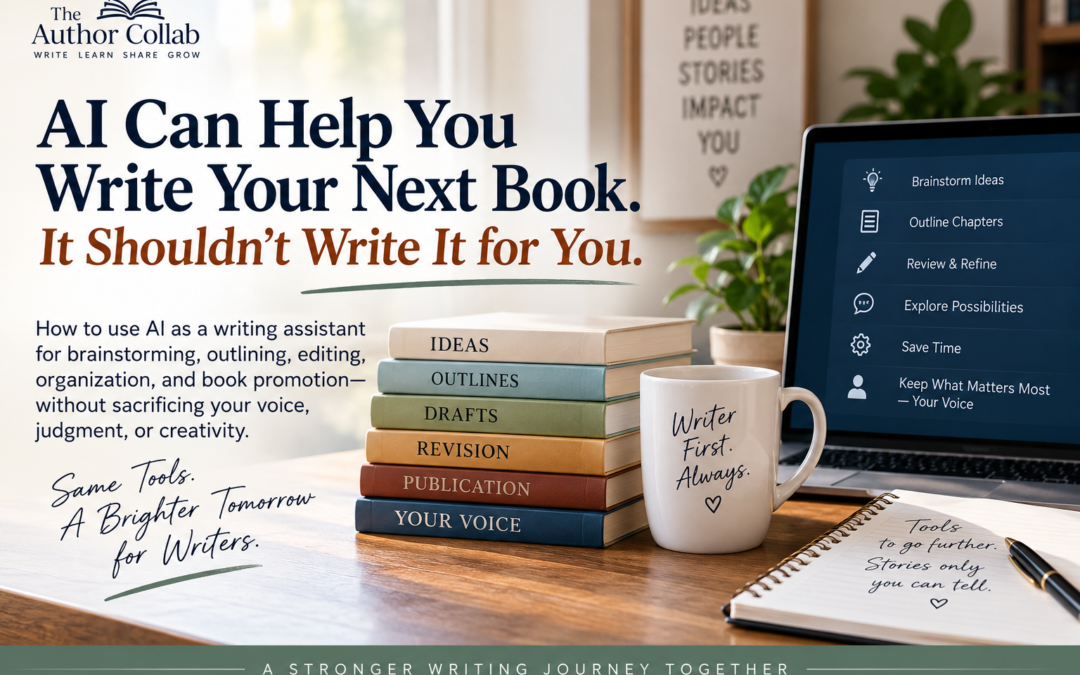
How to use AI as a writing assistant for brainstorming, outlining, editing, organization, and book promotion—without sacrificing your voice, judgment, or creativity.
Use AI to Assist Your Writing—Not Replace the Writer
AI can help you brainstorm, organize, research, refine, and save enormous amounts of time. But your next book still needs something AI cannot bring to the page: you.
There seems to be an ongoing conversation among writers about artificial intelligence: Should authors use it? Is it cheating? Will it replace writers? Does using AI somehow make the work less authentic?
I think we may be asking the wrong question.
Instead of asking whether writers should use AI, perhaps we should be asking:
How can writers use AI without giving away the very things that make their writing worth reading?
I use AI regularly. I use it for images, brainstorming, outlining, organizing information, reviewing documents, generating possibilities, and helping me see my own work from a different perspective.
But I don't think of AI as the writer.
I think of it as the assistant.
Give AI the Busywork. Keep the Thinking.
One of my favorite ways to use AI is to upload something I have already created and ask it to review the document.
Sometimes I ask:
- Is this organized logically?
- Am I repeating myself?
- Is anything missing?
- Would another sequence make this easier for the reader to follow?
- What supporting material might make this more useful?
- Does the table of contents accurately reflect what is actually in the book?
The answers don't automatically become changes.
They become possibilities.
That distinction matters.
AI may suggest moving a chapter, adding a section, eliminating repetition, creating a checklist, or explaining something more clearly. Sometimes I immediately see the value in the suggestion.
Other times, I think, No. That's not what I want to say.
And that's exactly how it should work.
The author remains the decision-maker.
Teach Your AI How You Work
AI becomes particularly useful when you give it examples instead of expecting it to guess what you want.
For example, I recently uploaded a copyright page from one of my existing books. Instead of explaining every detail of how I wanted the next one structured, I could essentially say, "This is how I do it."
Now there was a model to work from.
I've done the same thing with press releases.
For years, I wrote press releases from scratch. I knew the format and could certainly write them, but they could easily take an hour or more.
Today, I can provide the essential information—the who, what, when, where, why, quotes, background, links, and contact information—and ask AI to create the first draft.
In minutes, I have something to work with.
Sometimes the draft is remarkably close to what I would have written myself. Why? Because I've given AI the information, examples, context, and direction it needs.
I still review it. I still change things. I still make sure it sounds like me. But I'm no longer spending an hour staring at a blank page doing something I've already done dozens—or hundreds—of times before.
That's not replacing my creativity.
That's giving me more time for it.
AI Can Expand the Possibilities
Another area where I've found AI particularly useful is brainstorming.
Recently, I was exploring domain names for new projects. I might begin with one idea and then ask AI for synonyms, related phrases, alternate expressions, word combinations, or entirely different ways of communicating the concept.
One idea suddenly becomes 20.
One phrase leads to another.
And occasionally, somewhere in that list is an idea I never would have considered on my own.
But this is also where the limits of AI become important.
AI can suggest a fabulous domain name.
That doesn't mean the domain is available.
It doesn't mean someone hasn't trademarked the phrase.
It doesn't mean another company is already using something confusingly similar.
And it certainly doesn't mean I should immediately build a brand around it.
AI can help generate the idea. I still have to do the due diligence.
Let AI See What You Can't See
Writers have another problem that AI can sometimes help solve:
We get too close to our own work.
When you've read a manuscript 27 times, you don't always see what a new reader will see. You know what you meant. You know why Chapter 4 follows Chapter 3. You know the story behind the story.
The reader doesn't.
AI can sometimes act as another set of eyes.
Ask it to identify gaps. Ask what questions a reader might still have. Ask whether two chapters overlap. Ask whether your promise in the introduction is actually fulfilled by the book. Ask which ideas deserve more explanation.
Again, AI isn't necessarily right.
But the questions and observations can make you think differently.
And sometimes that's exactly what a writer needs.
Where AI Should Stop
There are things I don't want to outsource.
My experiences.
My opinions.
My judgment.
My stories.
My values.
My perspective.
My voice.
Those are the things that make my writing mine.
If ten authors ask AI to explain the same concept, AI can probably produce ten perfectly competent explanations.
But if you ask ten authors to tell you about the moment they learned that lesson, the mistake that changed them, the person who challenged their thinking, the failure they still remember, or the experience that shaped what they believe today, you'll get ten completely different stories.
That's where the writer lives.
AI can help you organize the story.
It can ask questions that help you remember details.
It can suggest where the story might fit.
It can point out that the lesson isn't quite clear yet.
But it didn't live the story.
You did.
Your Voice Should Survive the Edit
There's another temptation writers need to watch for.
AI can make almost anything sound polished.
Sometimes too polished.
A quirky sentence becomes conventional. An unusual turn of phrase disappears. Humor gets cleaned up. Personality gets smoothed away.
Suddenly, the writing is grammatically lovely—and sounds like everyone else.
Don't let "better" become less you.
One of the most useful instructions you can give AI is not simply, "Make this better."
Instead, tell it what you want preserved.
You might say:
"Improve the flow without changing my conversational voice."
"Point out repetition, but don't remove anything yet."
"Suggest edits rather than rewriting the passage."
"Help me make this clearer while preserving my humor and sentence style."
Or my personal favorite approach:
Tell me what isn't working before you try to fix it.
That keeps you involved in the process.
AI Is Not the Final Authority
For all its usefulness, AI is not infallible.
It can make mistakes.
It can confidently present incorrect information.
It may rely on outdated information or misunderstand the context of a question. And there is an enormous amount of questionable information available online in the first place.
That means authors still have responsibilities.
If you are including statistics, quotations, historical information, legal or medical claims, research findings, attribution, or other factual material in your book, verify it.
Find the original source whenever possible.
Check the date.
Check the context.
Confirm that the person you're quoting actually said what the internet claims they said.
In other words:
Use AI enthusiastically. Use it intelligently. But don't hand over your judgment.
We've Been Here Before
I sometimes think our anxiety about AI is partly anxiety about change.
We've seen versions of this before.
Calculators changed the way we did arithmetic.
Google changed the way we searched for information.
GPS changed the way we navigated.
Email changed the way we communicated.
Spellcheck changed editing.
Desktop publishing changed publishing.
And yes, some of us are old enough to remember when the calculator itself seemed revolutionary. Some may even remember the abacus!
Every new technology changes the way we perform certain tasks.
Eventually, the question stops being, "Should we use this?"
The better question becomes, "How do we use this well?"
AI is simply the latest tool we're learning to use wisely.
Your Next Book Still Needs You
If you're writing a book, AI can be an extraordinary partner in the process.
Let it help you brainstorm 30 chapter titles.
Let it organize your scattered notes.
Let it examine your table of contents.
Let it identify repetition.
Let it suggest questions you haven't answered.
Let it help turn a chapter into a checklist, worksheet, article, discussion guide, or reader resource.
Let it help draft the press release, brainstorm the domain name, create promotional ideas, and find new ways to talk about your book.
Let it do some of the work that used to consume hours of your time.
Then use those hours for the things only you can do.
Think. Question. Remember. Decide. Create. Tell the story.
Because AI can help you write a book.
But the wisdom, experiences, stories, perspective, and purpose behind that book?
Those still belong to the author.
Change block type or style
Move Heading block from position 137 up to position 136
Block Heading is at the end of the content and can’t be moved down
Change alignment
Change text alignment
Displays more block tools
And they should.
Ready to Put AI to Work on Your Next Book?
Knowing how to use AI is just as important as deciding whether to use it.
The Author Collab Resource Library now includes two practical collections created specifically for writers:
AI Prompts for Nonfiction Writers — prompts to help you brainstorm, organize, develop, strengthen, and expand your nonfiction book while keeping your expertise and perspective at the center.
AI Prompts for Fiction Writers — prompts designed to help you explore characters, plot possibilities, settings, conflict, dialogue, story development, and more—without asking AI to replace your imagination.
Think of them as conversation starters for your new writing assistant.
Explore the AI resources in The Author Collab Resource Library—and discover how much more useful AI becomes when you learn what to ask.