Wisdom from Writers Who Wrote the Books
There is something wonderfully intimidating about a blank page.
It doesn't matter whether you're writing your first book or your tenth. At some point, every writer faces the same blinking cursor and the same question:
Where do I begin?
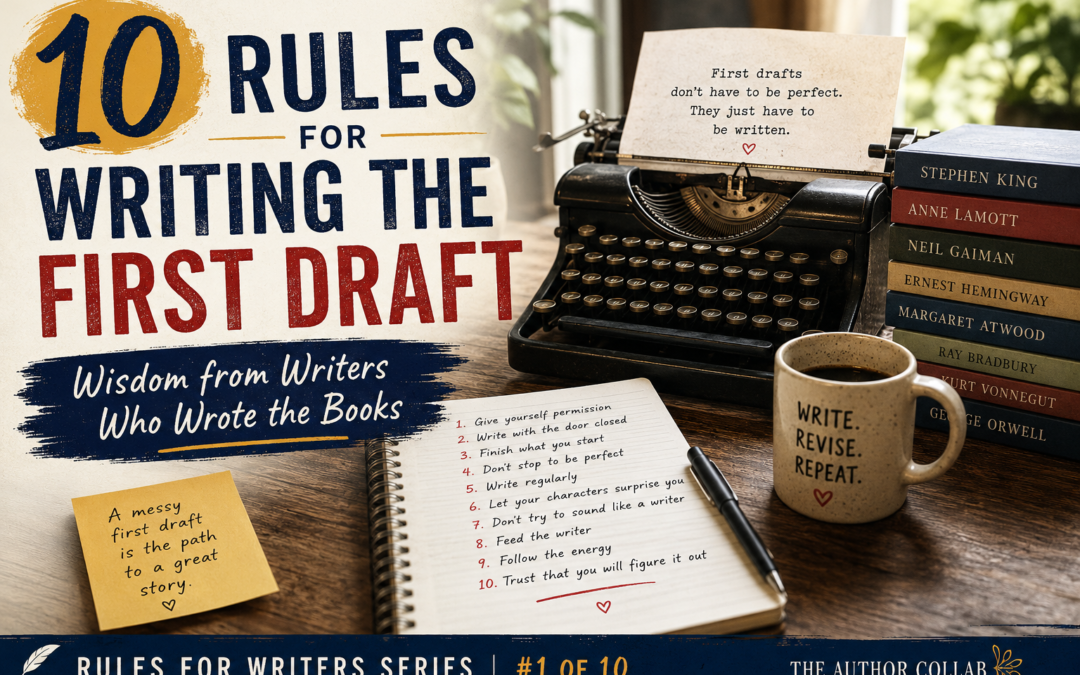
Fortunately, generations of writers have wrestled with that question before us. Stephen King, Anne Lamott, Neil Gaiman, Ernest Hemingway, Ray Bradbury, and others have shared what they've learned about getting words out of your head and onto the page.
Their approaches aren't always the same. In fact, some of their advice contradicts other writers' advice—and I rather like that.
Writing isn't a formula.
What works beautifully for one writer may completely derail another. The trick is discovering which advice helps you get your story written.
So, for the first installment of Rules for Writers from the Writers Who Wrote the Books, let's begin where every book begins:
The first draft.
Here are ten rules worth trying.
RULE #1: Give Yourself Permission to Write a Bad First Draft
Inspired by Anne Lamott
If you've read Anne Lamott's Bird by Bird, you probably already know the advice I'm talking about.
Lamott famously champions the necessity of imperfect first drafts. The point isn't to produce beautiful prose on the first attempt. The point is to produce something you can work with.
You cannot revise a blank page.
Perfectionism convinces writers that every sentence needs to be good before they move to the next one. That pressure can stop a book before it ever begins.
The first draft has a different job.
It exists to get the story, idea, argument, memory, lesson, or message out of your head.
Why It Matters
When you stop expecting your first draft to sound like a finished book, writing becomes considerably easier.
Your job isn't to impress anyone yet.
Your job is to keep going.
Try This
When you sit down to write, tell yourself:
Nobody has to see this version but me.
Then write accordingly.
RULE #2: Write With the Door Closed
Inspired by Stephen King
In On Writing, Stephen King describes writing the first draft with the door closed and later rewriting with the door open.
It's a wonderful metaphor.
During the first draft, protect the story.
Don't constantly ask:
Will people like this?
What will reviewers say?
Will my family recognize themselves?
Is this marketable?
Will someone disagree with me?
Those questions belong to another stage.
Why It Matters
The imaginary audience sitting on your shoulder can become a ruthless editor.
And editors—even imaginary ones—aren't particularly helpful when you're trying to create.
Try This
For one writing session, pretend the book will never be published.
What would you write if you knew nobody else would ever read it?
Write that.
RULE #3: Finish What You Start
Inspired by Neil Gaiman
Neil Gaiman's writing advice includes one deceptively simple instruction:
Finish things.
Writers are notoriously good at beginnings.
A new idea arrives and suddenly it seems infinitely more exciting than the chapter we've been wrestling with for three weeks.
So we start something else.
And something else.
Before long, we have seven fascinating beginnings and no finished book.
Why It Matters
Finishing teaches you things beginning never can.
You learn how to sustain an idea, solve problems, connect pieces, survive the messy middle, and bring something to a conclusion.
You also finally have something you can revise.
Try This
Before abandoning your current manuscript for your newest brilliant idea, write the new idea down somewhere safe.
Then return to the book you're already writing.
Your new idea will wait.
RULE #4: Don't Stop to Make Everything Perfect
Inspired by Ernest Hemingway
Hemingway was known for revising extensively, but one particularly useful part of his process was knowing how to keep momentum while drafting.
A first draft doesn't need perfectly researched dates, beautifully constructed transitions, or precisely chosen statistics.
Sometimes you simply need to keep moving.
Why It Matters
Every time you leave the manuscript to research something, check a fact, find the perfect quotation, or rewrite a paragraph seventeen times, you risk breaking the creative flow.
Try This
Use placeholders.
[CHECK DATE]
[FIND STATISTIC]
[BETTER EXAMPLE HERE]
[RESEARCH THIS]
Then keep writing.
There will be time to fix it later.
RULE #5: Write Regularly
Inspired by Stephen King
King is famous for his disciplined writing routine.
You don't need to adopt his schedule or anyone else's word-count goal. But there is something valuable about returning to your manuscript consistently.
Books are rarely written in one glorious burst of inspiration.
They're built in sessions.
Page after page.
Day after day.
Why It Matters
Regular writing keeps you connected to the manuscript.
When too much time passes between sessions, you spend precious writing time trying to remember where you were going.
Try This
Create a goal small enough that you can actually keep it.
Maybe it's 500 words.
Maybe it's 30 minutes.
Maybe it's three mornings a week.
Consistency beats an impressive writing schedule you abandon after ten days.
RULE #6: Let Your Characters Surprise You
Inspired by Kurt Vonnegut
Vonnegut believed characters should want something—even if it's something as simple as a glass of water.
Whether you're writing fiction or nonfiction, people create movement.
When characters—or real people in our stories—have desires, obstacles, contradictions, fears, and choices, the writing comes alive.
Why It Matters
Sometimes writers become so committed to an outline that they force the people in the story to behave according to plan.
But interesting things happen when you allow the story some room to breathe.
Try This
When you're stuck, ask:
What does this person want right now?
Then see where the answer takes you.
RULE #7: Don't Try to Sound Like a Writer
Inspired by George Orwell
Orwell's famous rules for clear writing favor simplicity over unnecessary complexity.
That's especially useful advice during a first draft.
Writers sometimes sit down at the keyboard and suddenly start using words they would never use in conversation.
The writing becomes stiff because they're trying to make it sound like Writing—with a capital W.
Why It Matters
Your natural voice is one of the few things another writer cannot duplicate.
Don't edit it out before you've even discovered it.
Try This
If a paragraph feels stiff, imagine explaining the idea to someone over coffee.
How would you say it?
Write that version.
RULE #8: Feed the Writer Before Asking Her to Produce
Inspired by Ray Bradbury
Bradbury frequently encouraged writers to read widely and fill themselves with stories, poems, essays, experiences, and ideas.
Creativity needs raw material.
Writing doesn't only happen while you're sitting at a keyboard.
It happens while you're reading.
Listening.
Traveling.
Talking to people.
Walking through a garden.
Watching strangers in an airport.
Living.
Why It Matters
When you continually feed your curiosity, you rarely arrive at the page completely empty.
Try This
Keep an idea pantry.
Save observations, phrases, questions, memories, interesting facts, overheard conversations, photographs, and ideas.
You never know which one will unlock tomorrow's chapter.
RULE #9: Follow the Energy
Inspired by Margaret Atwood
Writers don't always discover a book in chronological order.
Sometimes Chapter 8 desperately wants to be written while Chapter 3 refuses to cooperate.
Unless your process requires strict sequence, consider following the part of the manuscript that has energy.
Why It Matters
Momentum matters more than order during a first draft.
You can rearrange pages later.
You can't rearrange pages you never wrote.
Try This
Ask yourself:
What part of this book do I most want to write today?
Start there.
RULE #10: Trust That You Will Figure It Out
Inspired by writers everywhere
At some point during almost every first draft, the writer becomes convinced the book isn't working.
The middle is a mess.
The brilliant premise suddenly seems ridiculous.
Two chapters say essentially the same thing.
There's a hole the size of Montana between Chapters 6 and 7.
Welcome to writing.
A messy manuscript isn't evidence that you can't write.
It's evidence that you're in the middle of writing.
Why It Matters
You don't have to know how to solve every problem when you encounter it.
Sometimes the solution appears three chapters later.
Try This
When you hit something you can't solve, leave yourself a note:
[FIGURE THIS OUT LATER.]
And keep going.
Because there is one thing almost every accomplished writer seems to agree upon:
You cannot improve a book you haven't written yet.
Heidi's Take: The Rule I Learned Early
Anne Lamott's Bird by Bird was one of the first books about writing I read when I began writing my first book, and her philosophy about first drafts stayed with me.
Perhaps that's because it gives writers permission to be human.
We don't expect a painter's first brushstroke to be the finished painting. We don't expect the first rehearsal to sound like opening night. Yet writers sometimes expect the first words they put on a page to be worthy of publication.
They're not supposed to be.
I've learned that sometimes you simply have to get the words down. You can move them, improve them, expand them, shorten them, question them, and occasionally throw them out later.
But first, they have to exist.
And I've learned something else over the years:
Sometimes you don't know what you're really writing about until you start writing.
The story may lead somewhere you didn't expect.
Let it.
Which Rule Do You Follow?
Maybe you write every morning.
Maybe you jump around your manuscript.
Maybe you leave yourself dozens of notes that say [FIX THIS LATER].
Or perhaps you've developed a first-draft rule entirely your own.
I'd love to know:
What's one rule you follow when writing a first draft—and how did you learn it?
Share yours with The Author Collab community.
Your rule might even find its way into a future installment of Rules for Writers from the Writers Who Wrote the Books.
Because once you've written the book, you've probably learned a few rules worth sharing, too.