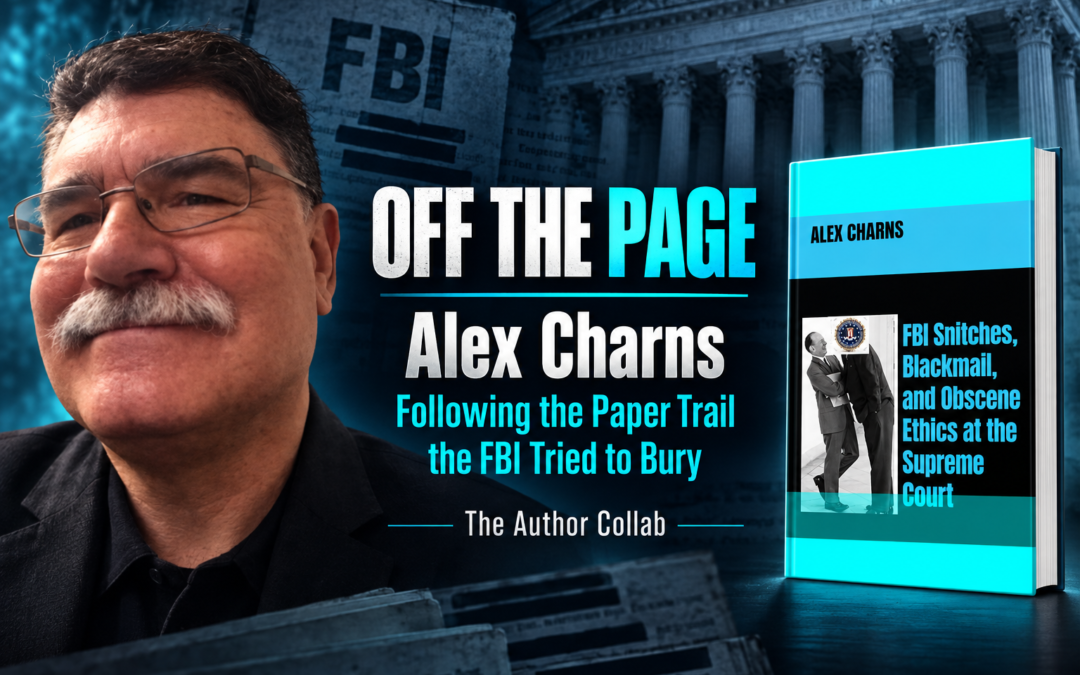
After 43 years of Freedom of Information requests and three federal lawsuits, attorney and author Alex Charns reveals what persistence can uncover about power, secrecy, and the nation’s highest court.
Some authors begin with a question. Alex Charns began with an answer he did not believe.
In 1983, the federal government told him that the FBI had no file on the United States Supreme Court. Charns—a criminal defense and police-misconduct attorney accustomed to examining official claims—was convinced that response was false. He kept digging.
What followed was a decades-long pursuit involving Freedom of Information Act requests, tens of thousands of pages of FBI records, and three federal lawsuits. His early investigation resulted in Cloak and Gavel: FBI Wiretaps, Bugs, Informers, and the Supreme Court, published by the University of Illinois Press in 1992. But even after that book was released, Charns believed the government was still withholding part of the story.
His latest nonfiction book, FBI Snitches, Blackmail, and Obscene Ethics at the Supreme Court, returns to that buried history with records obtained years later. In it, Charns argues that FBI Director J. Edgar Hoover and senior Bureau officials cultivated informants connected to the Supreme Court, obtained confidential information about the Court’s private deliberations, and used a sexual allegation as leverage against sitting Justice Abe Fortas.
The result is a work of documented history that moves with the tension of a legal thriller. It asks unsettling questions about institutional power: Who watches those entrusted with enforcing the law? What happens when courts fail to punish government misconduct? And how much history remains hidden because the people controlling the records prefer silence?
For this edition of Off the Page, Alex Charns discusses the document that changed his understanding of the Fortas story, the limits of the Freedom of Information Act, the philosophy he calls “Distrust and verify,” and what coaching youth hockey taught him about applying pressure until the truth breaks free.
The Interview
1. You spent 13 years and pursued three Freedom of Information Act lawsuits to obtain the FBI records at the heart of this book. What kept you going when it would have been much easier to decide you had pursued the story long enough?
When the government told me in 1983 that it had no file on the Supreme Court, I became a man obsessed because I knew that was not true. Tens of thousands of FBI documents later, I believed there was even more being hidden. Unfortunately, I did not learn how much more there was until after Cloak and Gavel had been published.
2. This book follows work you began decades earlier with Cloak and Gavel. When you finally obtained the additional records, was there a particular document or discovery that made you realize the story you thought you knew had fundamentally changed?
The FBI memo accusing Justice Fortas—before he joined the Court—of having a homosexual encounter. Other documents claimed the encounter was with a teenage boy.
The FBI used this allegation as leverage to blackmail Justice Fortas, who was already serving as a Bureau informant about the High Court’s private conference-room discussions concerning illegal FBI bugging.
3. Your book makes serious claims about the relationship between the FBI and Supreme Court Justice Abe Fortas. What do you believe the documents themselves establish, and where does your interpretation of those records begin?
The FBI documents establish the sexual blackmail of a sitting justice by Director J. Edgar Hoover and his minions. Whether the salacious accusation was true has not been definitively determined.
The Bureau protected Justice Fortas by hiding the documents for decades and never fully investigating what was then considered a criminal act—and, depending on the teenager’s age, a felony.
4. You have practiced criminal defense and police-misconduct law for more than 40 years. How has spending a career questioning government authority influenced the way you approach historical documents, official explanations, and institutional secrecy as an author?
I follow a version of President Reagan’s axiom about the Soviets: “Trust, but verify.”
I have amended it to: “Distrust and verify.”
5. Much of the information you uncovered remained inaccessible to Senate investigators, journalists, historians, and previous FOIA requesters for decades. What has this experience taught you about the importance—and the limitations—of the Freedom of Information Act?
The FOIA was limited only because of the false and misleading actions of FBI and U.S. Department of Justice attorneys and employees. The failure of our federal judges to punish this behavior was the icing on the dirty cake of misdirection and delay.
6. Your writing ranges well beyond this subject, including Queer Justice, Twenty Angels on Her Roof, and Listening to Chopin While Fighting Nazis. What connects the stories and subjects that compel you enough to spend months—or sometimes years—writing about them?
I write about dark times in our nation’s history and the people who step up to meet the monumental challenges of their time.
That was my family in occupied Poland during World War II. In my legal thrillers, it is the dedicated criminal defense attorneys.
7. Going “Off the Page”: After more than 40 years practicing law, years investigating FBI records, writing books and articles—and 15 years coaching youth hockey—what has hockey taught you about people or life that the courtroom never could?
Hockey has a penalty box to punish miscreants. Courtrooms need them, too, for wayward prosecutors and government officials who violate their constitutional oath to do justice.
Hockey also teaches you to forecheck—to be aggressive in the offensive zone. Keep up the pressure at all times. Your opponent will eventually make a mistake that either coughs up the puck or unearths a treasure trove of secret history that the government intended to keep from the public.
Persistence Is Part of the Story
Alex Charns’s work is a reminder that some books are not written on a convenient publishing schedule. They are assembled through years of requests, refusals, court filings, discoveries, and the stubborn conviction that the official answer is incomplete.
The documents at the center of FBI Snitches, Blackmail, and Obscene Ethics at the Supreme Court may concern events from decades ago, but the questions they raise remain urgent: How should powerful institutions be held accountable? What responsibility do courts have when government agencies mislead requesters? And what happens to public trust when important records remain hidden until the people involved are beyond questioning?
Charns did not stop when the government said the records did not exist. He did not stop after publishing his first book on the subject. He continued following the paper trail until newly obtained documents altered the story he thought he knew.
Perhaps that is the deeper lesson behind both his legal career and his hockey metaphor: pressure matters. Persistence matters. And sometimes history gives up its secrets only when someone refuses to leave the ice.
About Alex Charns
Alex Charns is an attorney and author whose 43 years of Freedom of Information Act requests and three federal lawsuits brought some of the FBI’s most closely guarded blackmail memos into public view.
His nonfiction books include FBI Snitches, Blackmail, and Obscene Ethics at the Supreme Court and Cloak and Gavel: FBI Wiretaps, Bugs, Informers, and the Supreme Court, published by the University of Illinois Press in 1992. Kirkus Reviews described his latest book as a damning examination of illegal FBI activity and the downfall of a Supreme Court justice.
Charns also writes memoir, history, legal thrillers, and political hockey humor. His books include Listening to Chopin While Fighting Nazis, Queer Justice, Twenty Angels on Her Roof, and the Star Gwiazda legal-thriller series, beginning with The Girl Who Wore a Hockey Helmet. His hockey titles include How Women’s Hockey Saved the World (and Defeated Donald Trump, but Not Necessarily in That Order) and How Hockey Saved the World (and Defeated George W. Bush, but Not Necessarily in That Order).
In addition to more than four decades practicing law, Charns spent 15 years coaching youth hockey—an experience that gave him an especially memorable metaphor for investigation: forecheck relentlessly and keep applying pressure until the puck, or the truth, comes loose.
Connect with Alex Charns
- Visit Alex Charns’s website
- Connect with Alex on LinkedIn
- Find FBI Snitches, Blackmail, and Obscene Ethics at the Supreme Court on Amazon
About Off the Page
Off the Page introduces readers to the authors behind the books—the experiences that shaped their work, the questions that kept them writing, and the lives they lead beyond the final chapter.
Because every book has a story behind it, and sometimes the most revealing chapter begins when we go Off the Page.